The first thing I noticed was the pause.
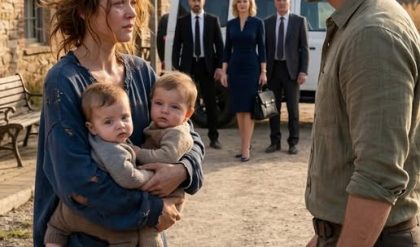
It was small—barely a beat—just long enough for the woman at the Disneyland entrance to stop looking like every other cheerful employee whose job depended on endless smiles and practiced patience. She had that automatic brightness when she took the tickets, the kind people wear when they’ve said “have a magical day” so many times it becomes muscle memory. She scanned the first ticket and nodded without thinking. She scanned the second—and something shifted behind her eyes.
Her smile didn’t fall. It tightened. Like it had to make room for a different emotion.
Around us, the world kept moving as if nothing was wrong. Families streamed through the gates in bright bursts of excitement. Children tugged at sleeves. Balloons bobbed. Somewhere nearby, a kid screamed with pure joy at the sight of Mickey-shaped everything. The park music played its familiar, engineered cheerfulness, designed to make even exhausted adults believe in happiness again.
In front of us, my sister Dana’s twins bounced with anticipation, clutching their red envelopes like winning lottery tickets.
Next to them stood my son.
Eli didn’t bounce. He didn’t talk. He just stood there, fingers curled tightly around the straps of his backpack, watching my face instead of the gates. He always did that—watched me first, the world second. Like I was the translator between him and whatever was about to happen.
That was what hurt the most.
Not the tickets.
Not even my parents’ decision.
It was the way my son had already learned to read disappointment in adults before he ever reached the rides.
The gate attendant scanned again. Her posture changed completely.
“I’m sorry,” she said, voice shifting into something more careful. “These tickets have been flagged. I need to call security.”
The words didn’t immediately make sense in the loud, festive space. They landed slowly, like stones sinking into water.
My sister Dana made a sharp inhale, half outrage, half disbelief. My mother opened her mouth, then closed it again. My father stepped forward, already forming the kind of explanation that assumes authority can rewrite reality.
But I wasn’t looking at them.
I was looking at Eli.
His confusion wasn’t loud. It was quiet. Controlled. The kind of confusion that comes from a child who has learned not to take up too much emotional space.
“Mom?” he whispered. “What’s wrong?”
I didn’t answer.
Because the truth was already unraveling in front of us.
And none of this started here.
It started that morning at breakfast.
My mother had placed two red envelopes on the table like she was performing a kindness. My sister Dana’s kids had squealed immediately, tearing into them with the entitlement of children who had never learned the difference between receiving and deserving.
Eli had waited.
He always waited.
Then, softly, he asked, “Grandma… where are ours?”
My mother hadn’t even looked at him properly.
“Oh, sweetheart,” she said lightly, like she was commenting on the weather. “The park is going to be very crowded today. You don’t do well with crowds, remember?”
Sensitive.
That was the word she always used when she meant inconvenient.
Dana added without looking up from her coffee, “Honestly, Eli would probably get overwhelmed anyway. You know how he is.”
I remember my son blinking at that. Not crying. Not reacting. Just absorbing it.
Like children do when they’re trying to understand a language no one bothered to teach them properly.
I should have spoken then.
I didn’t.
Because I had been trained in this family to confuse silence with peace.
Instead, I said, “We’ll meet you downstairs.”
And I told myself I was protecting him.
But what I was really doing was postponing a moment that was always going to arrive.
Now, standing at the gate, it had arrived anyway.
The attendant was speaking into her radio. Security was coming. The crowd was noticing.
And Eli… Eli was still looking at me.
Not the tickets.
Not the staff.
Me.
Like he already knew this was about more than Disneyland.
The first security guard arrived quickly. Then another. The energy around us shifted from festive to procedural in seconds. The kind of shift most people don’t notice until they’re inside it.
“Can I see identification?” one of them asked calmly.
My mother immediately stepped forward.
“This is ridiculous,” she said, forcing a laugh that didn’t land. “These are our tickets. There must be a mistake.”
The guard checked the screen. His expression didn’t change much, but something in his tone tightened.
“These tickets were reported as stolen this morning.”
Silence.
Not the dramatic kind.
The kind that removes oxygen from a space.
My father frowned sharply. “By who?”
The guard hesitated just long enough to make the answer heavy.
“The purchaser.”
That was the moment my mother looked at me properly.
Not casually.
Not briefly.
Properly.
And something in her expression changed.
Recognition.
Not of guilt.
Of exposure.
But still, she tried.
“There must be some mistake,” she said again, weaker now.
But I already knew there wasn’t.
Because that morning, before anyone else was awake, I had been in the hotel lobby with Eli while he watched cartoons on mute. I had gone to the concierge desk and printed something I should not have had access to.
A receipt.
Four tickets purchased.
Then quietly reassigned at midnight.
Two removed.
Two redirected.
Not lost.
Not mistaken.
Chosen.
Eli tugged my sleeve gently. “Mom… are we in trouble?”
“No,” I said immediately. “You are not in trouble.”
My voice didn’t shake.
That surprised even me.
Because something inside me had finally stopped bending.
Dana turned toward my parents, panic rising now. “Wait—why would they be reported stolen?”
Nobody answered her.
The second security officer spoke into his radio. More staff were approaching.
And then, behind us, I heard my mother’s voice cut through the noise.
“You always were jealous of your sister.”
It wasn’t loud.
It didn’t need to be.
It was sharp enough to freeze everything anyway.
For a second, I almost laughed.
Not because it was funny.
Because it was predictable.
Even now, even here, even with my son standing in the middle of something being taken from him, she still found a way to make it about me.
Jealous.
That word she used whenever reality didn’t match her preference.
I turned slowly.
“I didn’t take anything from her,” I said.
My mother’s lips pressed together. “Then why is this happening?”
And that was when the gate attendant spoke again, quietly but clearly.
“The original account holder reported unauthorized transfer of tickets. There’s also a note.”
She glanced down at her screen.
“The note states the tickets were reassigned after the child’s name was explicitly removed from the booking.”
Eli blinked up at me again. “Mom… what does that mean?”
I knelt down immediately.
It didn’t matter that people were watching now.
It didn’t matter that security had formed a loose circle around us.
It only mattered that my son’s voice had started to sound uncertain in a place that was supposed to be magic.
“It means,” I said gently, “that someone made a choice that wasn’t fair.”
“Did you do it?”
The question hit harder than anything else that morning.
“No,” I said. “I didn’t.”
He studied my face like he was measuring truth.
Then he nodded once, as if deciding to believe me even though the world around us was doing its best to suggest otherwise.
Behind me, Dana was arguing with security.
“This is a family misunderstanding,” she insisted. “We can fix this.”
But I already knew what had happened.
And I already knew why.
Because this wasn’t the first time my son had been quietly excluded from something “for his own good.”
Dinner invitations that never included us.
Trips we only heard about afterward.
Group photos where he was conveniently “missed.”
Each time, it was explained the same way.
He’s sensitive.
He wouldn’t enjoy it.
He’d slow everyone down.
As if sensitivity was a flaw instead of a way of experiencing the world more intensely than they ever could.
The head security officer stepped closer.
“Ma’am,” he said to my mother now, “we need to resolve this off to the side.”
My father bristled. “Do you know who we are?”
I almost smiled at that.
Because I suddenly realized how fragile that sentence really was.
We need to resolve this off to the side.
Like truth could be negotiated in private.
Like pain could be contained if no one else saw it.
But the park didn’t care who we were.
And neither did my son anymore.
Eli squeezed my hand.
“Can we still go?” he asked quietly.
That question nearly broke me.
Because he wasn’t asking for justice.
He was asking for hope.
And I had no answer I could give him that wouldn’t involve disappointment.
“I don’t think so, sweetheart,” I said softly.
Behind us, one of the staff members spoke into a radio again.
Then the gate attendant looked up.
“I’m very sorry,” she said, voice now fully professional. “These tickets have been deactivated. They cannot be used.”
Dana let out a sharp, angry breath. “This is insane!”
My mother turned to me again.
And this time her voice dropped.
“This is what happens when you make things difficult.”
Something inside me finally snapped—not loudly, not dramatically, but cleanly.
Like a line that had been stretched too far for too long.
I stood up.
Slow.
Controlled.
Not angry.
Just done.
“You didn’t take tickets from me,” I said.
I looked at all of them.
“You took them from him.”
Eli looked up at me again.
And for the first time that morning, I saw something shift in his expression.
Not confusion.
Understanding.
The kind that comes too early in children who are forced to see patterns adults pretend don’t exist.
Security stepped closer, asking us to move aside.
My parents were still arguing.
Dana was still insisting.
But I was already taking Eli’s hand again.
And this time, he didn’t hesitate.
We walked away from the gates.
Behind us, the noise of the park continued like nothing had happened.
But something had.
Because on the way back to the car, my phone buzzed.
A message.
From my mother.
You are making a scene over nothing.
I stared at it for a long moment.
Then I looked at my son, sitting quietly beside me, staring out the window at a place he would not enter today.
And I realized something very simple.
This wasn’t nothing.
This was everything.
And for the first time in years…
I wasn’t going to pretend otherwise.
The car started.
We drove away.
And I didn’t look back.
The End