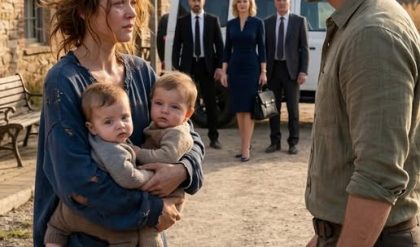
The coffee pot shattered with the sound of a small explosion, but it was nothing compared to the detonation occurring in my chest. Standing there in a faded waitress apron, her hair pulled back in a messy, desperate bun, was Sarah.
Sarah.
The woman who, seven years ago, had been the love of Mitchell’s life. The woman we were told—by the military brass, by the telegrams, by the official reports—had died in a tragic car accident shortly after Mitchell’s unit was deployed. We had buried them both in our hearts, mourning a tragedy that was supposed to be final.
But here she was. Older, thinner, and eyes wide with the terror of a woman who had been hiding from a ghost for nearly a decade.
“Sarah?” Derrick whispered, his voice cracking. He stood up so quickly his chair screeched against the linoleum.
The diner went deathly quiet. The cook peered through the service window, and the few locals at the counter turned, sensing that a private trauma had just crashed into the public space.
Sarah’s hands began to tremble violently. She looked at the five of us—five men weathered by time, war, and the heavy, lingering guilt of being the ones who survived while Mitchell didn’t. She looked at the little girl, whose name I now knew was Lily, and then she looked at Buster, the dog who was still leaning against my leg, his tail thumping a soft, mournful rhythm against the floor.
“You weren’t supposed to be here,” Sarah whispered, her voice barely audible. “You were supposed to be miles away. You were supposed to be driving to the cemetery.”
The Lies Beneath the Surface
We didn’t let her run. We didn’t let her retreat into the kitchen. We moved as one—five brothers who had spent seven years questioning the narrative of that day.
We ushered her into a back storage room, the air thick with the smell of flour and stale grease. Lily sat on a stack of crates, her eyes wide but strangely calm, while Buster took up a sentry position at the door, his eyes locked on us with an intelligence that felt unnervingly human.
“Sarah, talk to us,” I said, keeping my voice as steady as I could. “The military told us Mitchell was an orphan. They told us you were dead. They told us Buster died in the blast. We have spent every anniversary of his death blaming ourselves for leaving him behind. What is happening?”
Sarah began to cry—not a soft weeping, but the dry, racking sobs of someone who had been holding their breath for seven years.
“Mitchell didn’t die,” she said.
The room tilted on its axis.
“The blast,” she continued, “it was a setup. The unit he was with… there were people in the chain of command who knew about the intelligence he had uncovered. It wasn’t an ambush by the enemy, not entirely. It was a cleanup operation. Mitchell realized it, and he realized he couldn’t protect me if he returned as a hero. He had to be dead.”
She reached out, touching Lily’s hair.
“He pushed me out of my car that night seven years ago. He told me to disappear. He told me that if they thought I was dead, and if they thought he was dead, they would stop looking for the files he had hidden.”
The Missing Piece
“Where is he?” Derrick demanded, his hand hovering over his belt where his sidearm usually sat. “If he’s alive, why hasn’t he reached out? Do you know what we’ve lived through?”
Sarah reached into her apron pocket and pulled out a battered, silver locket. She clicked it open and slid a photograph toward us. It wasn’t Mitchell in his uniform. It was a photo of a man in a prison jumpsuit, taken from a distance, behind layers of chain-link fence.
“He isn’t free,” she said. “He’s in a black site. A military prison, off the books. He’s been there for seven years, and every day, he’s being interrogated about the location of those files. He isn’t talking because he knows the moment he tells them, they’ll kill him—and then they’ll come for us.”
The room went cold. The conspiracy wasn’t just a rumor; it was a living, breathing machine that had been churning away in the dark while we held memorial services and cried over empty coffins.
“The dog,” I said, looking down at Buster. “How?”
“Buster was supposed to be put down,” Sarah said. “Mitchell’s commanding officer—the one who signed the death warrants—took Buster. He kept him as a trophy, a sick reminder of the man he thought he’d broken. Buster escaped two years ago. He found me. He knew where I was because he still had Mitchell’s scent on the clothes I’d kept in a storage unit.”
The Reckoning
That was the moment the diner doors swung open again.
It wasn’t a customer. It was a man in a dark suit, his movements too precise, his eyes too cold. He wasn’t local. He held a suppressed weapon in his hand, and he was scanning the room with the practiced ease of an assassin.
“Five men,” the man said, his voice carrying clearly into the storage room. “Five veterans. We’ve been tracking your GPS for three days. You’ve become a nuisance to the legacy of the department.”
Buster growled—a low, tectonic rumble that vibrated through the floorboards.
We didn’t speak. We didn’t negotiate. We moved with the synchronization of a team that had once been the finest special ops unit in the country. We weren’t the young soldiers we used to be, but the muscle memory remained.
I kicked the door open. Derrick took the flank. The others moved to neutralize the threat before he could even raise his weapon. It was over in seconds—a flurry of movement, a sharp crack of a suppressed shot, and then silence.
We stood over the man, his credentials already in his jacket pocket. He was military intelligence. A cleaner.
“He’s not the only one,” I realized, the weight of the situation crashing down on us. “If they sent him, they know we’re here. They know about Sarah. They know about Lily.”
The Long Road Home
The cemetery drive was forgotten. The annual ritual of grief was replaced by a new, violent mission: The extraction.
We spent the next forty-eight hours in a blur of movement. We used the skills Mitchell had taught us—the ones we thought we’d never need again. We moved Sarah and Lily to a safe house, we scrubbed our digital footprints, and we began the agonizing, dangerous work of mapping the black site where Mitchell was being held.
It wasn’t easy. It wasn’t a movie. There were moments of sheer terror, times when we thought we would be exposed, and times when Buster’s sharp instincts saved our lives by sniffing out trackers hidden in our own gear.
When we finally breached the site—a nondescript facility in the middle of the Appalachian wilderness—we didn’t find a hero. We found a shadow.
Mitchell was gaunt, his skin pale from years without sunlight, his eyes reflecting a thousand horrors. But when he saw us—when he saw the five men he had saved seven years ago, and when he saw the dog trot through the door to press its head against his broken hands—the man I remembered returned.
“You shouldn’t have come,” he rasped, his voice sounding like grinding stones.
“We don’t leave men behind,” I said, putting a hand on his shoulder. “Not ever again.”
The Aftermath
We didn’t go back to the life we had before. We couldn’t. The world of shadows doesn’t let you simply walk away. But we had something better. We had the truth.
The documents Mitchell had been protecting were released. They didn’t bring down the whole government—that’s not how the world works—but they brought down the men who had orchestrated the ambush. They brought down the legacy of the officers who had played God with our lives.
Sarah, Mitchell, Lily, and Buster eventually moved to a place where the sun always shines, a quiet corner of the world where the ghosts of the past can’t follow.
As for us, we still take that drive every year. But we don’t go to the military cemetery anymore. We go to a small, private home nestled in the mountains. We sit on the porch, we drink black coffee, and we watch a seven-year-old girl play with a gray-muzzled German Shepherd.
And sometimes, we see Mitchell sitting there, looking out over the horizon, finally at peace.
He didn’t just survive the war; he survived the betrayal. And so did we.
The ambush didn’t kill the sixth man. It just taught us that the hardest battles aren’t the ones you fight on the field—they’re the ones you fight for the people you love, long after the smoke has cleared.
The end.