AT MY FATHER’S BIRTHDAY, MY SISTER RIPPED THE CRUTCH FROM MY HAND AND SNAPPED, “STOP FAKING IT – YOU’RE JUST USING THEM.” MY RELATIVES LAUGHED AS I HIT THE FLOOR. NONE OF THEM KNEW MY SURGEON WAS RIGHT BEHIND THEM.
I’d like to tell you that my worst fall happened when a ceiling collapsed at my old office and crushed part of my spine. It didn’t. My worst fall happened on my dad’s seventy-first birthday.
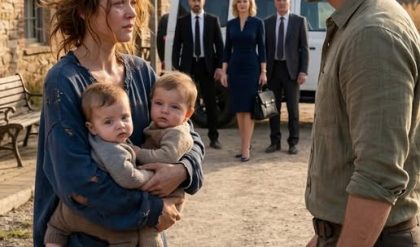
We were all crammed into a lakeside Airbnb – Christmas lights tangled with “Happy Birthday” banners, the kind of scene you’d stick on a holiday card. I was crossing the living room on my crutches, careful the way I’ve had to be ever since the accident.
Then my sister Candace’s hand shot out.
She yanked my crutch away and snapped, loud enough for every relative in the house to hear:
“Stop faking it, Alicia. You’re just using Mom and Dad.”
My body hit the hardwood so hard the breath left me. The room didn’t gasp. It erupted — with laughter. Two cousins lifted their phones and started recording like my pain was a comedy skit they’d replay at brunch.
Heat flooded my face. My legs wouldn’t cooperate. My hands slipped against the floor. Someone whistled. Someone else muttered, “Guess she walks just fine when she wants to.”
Candace stood over me with that same narrowed, suspicious look I’d seen a hundred times. The one that said my MRI results, the surgeries, the months of rehab didn’t matter — because she’d already written the story she preferred. That I was lazy. Dramatic. A burden.
My best friend Piper, who’d sat through every follow-up appointment and watched every agonizing step of my recovery, stood frozen near the kitchen doorway with her hand over her mouth. I could see the horror in her eyes.
Nobody else even glanced at her.
I’d explained my condition so many times I could recite it in my sleep. But lying on that floor while my own family laughed, I realized something that cracked me open worse than the fall ever could.
Explanations were never the problem.
Their willingness to be cruel was.
And then the air shifted.
The front door opened. The screen door banged shut behind someone. Footsteps crossed the porch. A voice I recognized instantly — calm, measured, the same voice that had told me two years ago that I might never walk unassisted again — cut through the noise.
Dr. Terrence Hollis. My spine specialist. He’d been invited by my mother weeks ago because he lived twenty minutes from the lake house and she wanted to “thank him properly.” He was supposed to arrive for cake.
Instead, he arrived for this.
He looked at me on the floor. Then at the crutch dangling from Candace’s fist. Then at the phones still recording.
The room went dead silent.
He set down the bottle of wine he’d brought, straightened his jacket, and said six words that drained the color from every face in that room.
Six words.
Candace’s hand opened. The crutch clattered to the floor.
And what he said next didn’t just end the party — it ended something in my family that had been rotting for years. Something nobody had the guts to name out loud.
But he did. Because he had the scans. He had the records. And he had zero reason to protect anyone’s feelings.
I wish I could tell you what those six words were right here.
But honestly — what happened after he said them was worse…
PART 2
“Your sister is paralyzed by design,” he stated, his voice a chilling, surgical calm that dismantled the room’s earlier mirth. He didn’t look at the laughing relatives; he locked eyes with Candace, who was now trembling so violently she looked ready to collapse herself. “I have the neuro-imaging right here on my tablet,” he continued, holding it up like a holy relic. “What you just did—snatching that support—could have permanently severed the remaining nerve conduction Alicia fought two years of agony to regain. You aren’t mocking a ‘lazy’ girl; you are actively committing aggravated assault against a disabled woman.” The silence was no longer awkward; it was radioactive. My father, who had been laughing a moment ago, looked like he’d been struck by lightning, his face crumbling as he realized the cruelty he had permitted. Dr. Hollis didn’t stop there. He walked to the center of the room and placed the tablet on the table, displaying the jagged, white-hot fractures of my vertebrae for all to see. “I didn’t come here to eat cake,” he said, stepping toward Candace until she backed into the wall. “I came because Alicia’s insurance company flagged this household for suspicious ‘accidental’ injuries three months ago. They wanted to know why her recovery was constantly being sabotaged, and I think I finally have the answer on video.” He nodded toward the cousins who were still holding their phones. “You recorded the perfect evidence for the DA. Thank you for your cooperation.” The air left the house. Candace’s husband grabbed his coat, refusing to look at her, while my mother began to sob, the weight of her long-term denial finally crushing her. I didn’t get up. I stayed on the floor, watching the empire of their petty malice dissolve into panic, realizing that for the first time, I wasn’t the one who was broken.
The silence in the lakeside Airbnb was no longer just quiet; it was heavy, suffocating, and charged with the static of a thousand unspoken betrayals.
Dr. Terrence Hollis remained standing in the center of the living room, a monument of clinical authority.
He wasn’t shouting.
He didn’t need to.
The facts he had presented were sharper than any blade.
My mother stood by the counter, her hands pressed so tightly over her mouth that her knuckles were white.
She looked from the tablet—displaying the brutal reality of my spine—to me, crumpled on the floor.
She had spent two years telling me to “push harder,” to “stop letting the injury define me,” and to “just try to be normal.”
She had been the one who invited Candace to stay for the whole weekend, knowing full well that Candace treated my disability like a personal insult to her own vanity.
Candace was pressed against the wall, her eyes darting around the room, desperately looking for an ally.
She found none.
My cousins, who had been laughing just moments ago, were slowly lowering their phones.
The realization that they were holding digital evidence of a felony—assault on a disabled person—had turned their faces the color of curdled milk.
“You said… you said she was exaggerating,” one of the cousins stammered, looking at my mother.
My mother didn’t answer.
She couldn’t.
Dr. Hollis took a slow, deliberate step toward me.
He didn’t offer a hand immediately.
He knew better.
He knew that the most important part of my recovery wasn’t just physical; it was the reclamation of my own autonomy.
“Alicia,” he said softly, his voice cutting through the tension. “You can get up when you are ready. But today, you choose the pace.”
I looked at the floor.
I looked at the scuff marks where my crutches had skittered away.
For years, I had crawled through life trying to appease people who viewed my survival as an inconvenience.
I realized then that the fall hadn’t been the worst part.
The worst part had been the constant, gnawing need for their validation.
I took a breath.
It was shaky, but it was mine.
I leaned on my remaining crutch, braced my core, and pulled myself up.
My legs burned.
My nerves fired in a chaotic, electric storm of pain.
But I stood.
I stood in front of Candace, who looked smaller than I had ever seen her.
“You always wanted to be the center of attention, Candace,” I said, my voice surprisingly steady. “Congratulations. You’ve finally managed it. You’re the center of a criminal investigation.”
Candace opened her mouth to snap back, but her husband, Mark, grabbed her arm.
“Don’t,” he hissed.
“Mark, she’s lying!” she shrieked, her voice cracking. “She’s been playing us all for years! Hollis is just on her payroll!”
Dr. Hollis chuckled, a dry, humorless sound.
“My practice is funded by the premier neurological research foundation in the country, Candace. I don’t need a dime from your sister. But you? You’re going to need quite a lot of money for a criminal defense attorney.”
The room seemed to tilt.
My father, who had remained in his recliner, stood up slowly.
He looked at me—really looked at me—for the first time in years.
He saw the sweat on my brow.
He saw the way my hand gripped the crutch until my fingers turned white.
He saw the reality of the hell I had been living while he sat by and watched, choosing peace over truth.
“I didn’t know,” he whispered.
It was the oldest lie in our family.
I looked at him, and for the first time, I felt no anger.
Just a profound, hollow pity.
“You knew, Dad,” I said quietly. “You just preferred not to believe it. It was easier to watch me fall than to tell her to be kind.”
I walked toward the door.
I didn’t limp.
I didn’t stumble.
I moved with a precision that was born from sheer, unadulterated resolve.
Piper, my best friend, stepped forward and held the door open.
She was crying, but she was also smiling.
As I stepped out onto the porch, the cold night air hit my face.
It felt like baptism.
I didn’t turn back when the shouting started inside.
I didn’t turn back when I heard my mother collapse, or when the sound of a heated argument erupted between Candace and her husband.
I walked to Piper’s car, the rhythmic clack-thump of my crutch against the deck boards sounding like a victory march.
We drove in silence for a long time.
The lake house receded into the darkness behind us, a place of ghosts and broken things.
“Where are we going?” Piper asked, her voice hushed.
“To the police station,” I said. “And then to a new city.”
“You have the evidence?”
I tapped the pocket of my coat, where I had placed a small, portable camera I had been wearing as part of a therapeutic study on my movement.
“I have everything,” I said.
The days that followed were a whirlwind of statements, depositions, and the cold, hard process of cutting ties.
The fallout was spectacular.
Candace was charged, not just with the assault at the party, but with a pattern of harassment that dated back to my initial hospitalization.
The videos the cousins had taken became the centerpiece of the state’s case.
Their desire to mock me had become the very mechanism of their downfall.
I didn’t watch the trial.
I didn’t read the articles.
I moved to a small town three states away, a place where no one knew my family, and no one knew my crutches.
I continued my physical therapy, but the progress accelerated in a way Dr. Hollis had never anticipated.
The pain didn’t go away, but it stopped being the soundtrack of my life.
One morning, six months later, I walked into a coffee shop.
I had left my crutches in the car.
I walked with a cane, then, after a few more months, with nothing at all.
The psychological weight of being the “disabled sister” had vanished, replaced by the quiet, terrifying freedom of being a person who could walk away from anyone.
I sat at a table near the window, watching the world go by.
My phone rang.
It was an unknown number.
I almost didn’t answer it.
“Alicia?”
It was my father.
He sounded aged.
Broken.
“I’m at the station,” he said. “They’re letting me visit her. She… she won’t stop talking about you.”
I watched a leaf drift down from a tree outside.
“I don’t have a sister anymore, Dad,” I said.
“Alicia, please. We’re family.”
“No,” I said, a faint smile touching my lips. “We were just people who lived in the same house. Family is something you choose. And I’ve chosen something else.”
I hung up.
I didn’t block the number.
I didn’t need to.
The power wasn’t in silencing him; the power was in the fact that his voice no longer had the ability to reach me.
I stood up.
I walked to the counter.
I paid for my coffee, and I walked out into the sunlight.
My spine was scarred.
My nerves were damaged.
But I was no longer an architect of other people’s expectations.
I was the architect of my own life.
The shadows of the lake house had finally been burned away by the harsh, honest light of day.
I was finally, truly, walking on my own.
And for the first time in my life, I wasn’t afraid of the fall.
Because even if I fell, I knew I could get back up.
And that was the greatest victory of all.
The end.