My Billionaire Ex-Husband Sat Beside Me on a Flight Just to Humiliate Me—Then Three Little Boys Ran Out of a Bentley Calling Me “Mom”
Five years after my divorce, my billionaire ex-husband deliberately sat beside me on a first-class flight just to remind me of everything I had lost. He thought I was alone. He thought I had spent years regretting our marriage ending. What he didn’t know was that when we landed in Chicago, three little boys would come running toward me from a waiting Bentley—and the truth he had been missing for five years was about to shatter everything he believed.
My name is Emma Winters, and the last person I expected to see that morning was Blake Harrington.
The moment he stepped into the first-class cabin, I recognized him instantly.
Five years had passed since our divorce, but some people leave scars that time never completely erases.
For a brief second, our eyes met.
Then his expression hardened.
“You’ve got to be kidding me,” he said.
I closed the book in my lap.
“Trust me, Blake. If I’d known you were on this flight, I would’ve driven.”
A few nearby passengers glanced toward us.
Blake seemed to enjoy the attention.
The flight attendant looked at his ticket.
“Mr. Harrington, your seat is—”
“I know where my seat is.”
To my disbelief, he sat directly beside me despite several empty seats in the cabin.
“There are other places you could sit,” I said.
“I know.”
“Then why here?”
A cold smile touched his lips.
“Five years of silence. I figured we should catch up.”
I looked back out the window.
“You always confused cruelty with confidence.”
“And you always confused secrets with innocence.”
My stomach tightened.
There it was.
The same accusation that destroyed our marriage.
Five years earlier, Blake and I had been one of New York’s most admired couples. He was the billionaire founder of a clean-energy empire. I was the environmental scientist who helped build much of the technology behind it.
Together, we were everywhere.
Magazine covers.
Charity galas.
Business conferences.
People called us unstoppable.
Then one night everything collapsed.
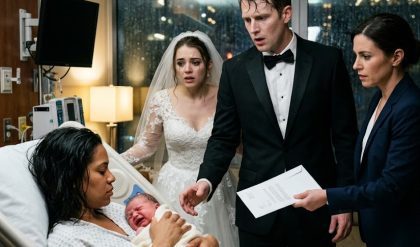
Blake found several messages on my phone.
Messages he misunderstood.
Messages I never got the chance to explain properly.
I still remembered standing in our penthouse while Manhattan glittered outside the windows.
“Who is he?” Blake demanded.
“There is no affair.”
“Then explain these messages.”
But he never wanted an explanation.
He wanted confirmation.
Within months, lawyers became involved.
Trust vanished.
And our marriage died.
Now, five years later, we sat side by side thirty thousand feet above the ground.
“You disappeared,” Blake said suddenly.
“I moved on.”
“Without taking a single dollar.”
“I didn’t want your money.”
That answer seemed to bother him.
For the next several hours, the conversation drifted between silence and old wounds.
Neither of us admitted how much it still hurt.
When the plane finally landed in Chicago, I was relieved.
I grabbed my bag and headed toward the terminal.
Behind me, I could feel Blake watching.
Outside the airport, black SUVs lined the curb.
Executives.
Drivers.
Security teams.
The usual world Blake inhabited.
Then a black Bentley pulled forward.
The rear door flew open.
Three little boys jumped out.
“Mom!”
The shout echoed across the pickup area.
Before I could react, all three came running toward me.
One wrapped himself around my waist.
Another grabbed my hand.
The youngest nearly knocked me backward with the force of his hug.
I laughed through unexpected tears.
“Hey, my sweet boys.”
Then I looked up.
Blake hadn’t moved.
He stood frozen beside the curb.
His face had gone completely white.
Because all three boys had my eyes.
But they had his face.
The same dark hair.
The same smile.
The same unmistakable Harrington features.
For several long seconds, nobody spoke.
Then Blake took one slow step forward.
His voice barely worked.
“Emma…”
I turned toward him.
And for the first time in five years, I saw genuine fear in his eyes.
Because he had just realized the impossible.
The messages that ended our marriage had never been about another man.
And judging by the way he was staring at those boys, he was finally beginning to understand what he had truly lost all those years ago.
PART 2:
The youngest of my sons, Noah, pressed his cheek against my coat and whispered, “Mom, why is that man staring at us?”
I should have answered quickly.
I should have smiled and told him Blake was no one important.
But my throat tightened around every word I had buried for five years.
Beside me, Oliver and Ethan stood unusually still. They were only four and a half, but children had a way of understanding storms before adults admitted there were clouds. Oliver, the oldest by six minutes, narrowed his eyes at Blake with the same wary intelligence that had made his preschool teachers call him “an old soul.” Ethan clung to my hand, his little fingers tense. Noah, the baby of the three by nine minutes, simply looked between us, confused.
Blake Harrington stared at them like the world had vanished beneath his feet.
His gaze moved from Oliver’s dark hair to Ethan’s sharp little chin, then to Noah’s mouth, curved in a perfect miniature of his own.
“No,” Blake breathed.
I lifted my chin. “Don’t do this here.”
His eyes snapped to mine.
“Are they mine?”
The question landed between us like shattered glass.
A driver in a black suit stepped out of the Bentley and opened the rear door wider. “Ms. Winters?”
I nodded once, but I didn’t move.
Blake took another step toward us. “Emma.”
“No,” I said quietly. “Not in front of them.”
His jaw trembled, just once. It was so small most people would have missed it. I didn’t.
Because once, I had known every expression on that face.
Once, I had known when Blake was angry, when he was amused, when he was exhausted, when he was afraid.
And right now, he looked terrified.
Oliver pulled himself in front of Noah as if he could protect him with a dinosaur backpack and a determined glare.
“Mom,” he said, “can we go home?”
That broke me.
“Yes, sweetheart.” I kissed the top of his head. “We’re going.”
I guided the boys toward the Bentley.
Blake reached for my arm, then stopped himself before touching me.
“Emma, wait.”
I looked at his hand suspended between us.
Five years ago, that hand had signed divorce papers without hesitation. Five years ago, that hand had slammed a bedroom door while I stood barefoot and pregnant, trying to tell him the truth through tears he refused to see.
May you like
They Called the Housekeeper Mommy. But the Truth Waiting in That Mansion Was Far More Devastating Than Anyone Could Imagine M1
He Saw a Waitress Feed His Mother With Trembling Hands. He Never Imagined That One Small Act of Kindness Would Uncover the Greatest Secret of His Life M1
He Thought He Was Feeding a Stranger. He Was Walking Back Into the Debt That Made Him Rich M1
Now it hovered there, useless.
“You had five years to wait,” I said. “Now it’s my turn to leave.”
I climbed into the Bentley with my sons.
The driver shut the door.
Through the tinted window, Blake remained on the curb, surrounded by his cars, his assistants, his reputation, and all the power in the world.
For the first time since I had known him, none of it helped him.
The boys talked over one another the moment we pulled away.
“Mom, was he from your plane?”
“Why did he look sad?”
“Is he a bad guy?”
“Does he know Grandma?”
I closed my eyes for one second.
My mother, Grace Winters, sat across from us, elegant in a cream coat, her silver hair twisted neatly at the back of her neck. She had been waiting in the car, watching everything unfold from behind the tinted glass. Her face was calm, but her eyes were sharp.
She reached over and squeezed my knee.
“One question at a time,” she said gently. “Your mother just had a long flight.”
Noah climbed into my lap even though he was getting too big for it. “I missed you.”
“I missed you more.”
“That’s impossible,” Ethan said seriously. “Because we missed you infinity.”
Oliver crossed his arms. “Infinity plus one.”
I laughed despite the ache blooming in my chest.
For five years, they had been my whole universe.
They were born in the middle of a snowstorm, three tiny miracles with lungs powerful enough to terrify an entire hospital wing. Oliver came first, furious and red-faced. Ethan followed with a quiet stare, as if already studying the room. Noah arrived last, small and stubborn, refusing to cry until I touched his foot and whispered, “Come on, little man. I need to hear you.”
They had been early. Too early. I had spent weeks beside incubators, sleeping in hospital chairs, pumping milk at two in the morning, bargaining with every god I didn’t believe in.
Blake hadn’t been there.
He hadn’t known.
And that truth, which had once felt like survival, now sat beside me like a loaded gun.
The Bentley moved through Chicago traffic toward my mother’s townhouse in Lincoln Park. Outside, winter sunlight flashed against glass towers. Inside, my sons argued about whether spaghetti tasted better with meatballs or without.
But my phone kept vibrating.
Once.
Twice.
Then again.
I didn’t need to look to know who it was.
Blake.
My mother glanced at my bag. “You should turn it off.”
“I know.”
But I didn’t.
Another message appeared on the screen.
Emma. Answer me.
Then another.
Please.
The word looked foreign coming from him.
Blake Harrington did not say please. He commanded. He negotiated. He conquered. He entered rooms and made powerful people stand straighter.
But he had never been good at begging.
When we reached the townhouse, the boys raced inside toward the kitchen, where my mother’s housekeeper had already prepared hot chocolate. Their laughter filled the hallway, bright and careless.
I stood in the foyer, unable to remove my coat.
My mother shut the door behind us.
“How long before he comes?” she asked.
I swallowed. “Not long.”
“Then decide what you’re going to say.”
“I don’t know what to say.”
“Yes, you do.” Her voice softened. “You’ve had five years to practice.”
I looked toward the kitchen.
Oliver was telling Ethan not to spill marshmallows. Noah was singing some nonsense song about dragons and pancakes.
“They’re happy,” I whispered.
“They are loved,” my mother corrected. “Happiness changes. Love is what matters.”
My phone rang.
This time, I answered.
Neither of us spoke for a moment.
Then Blake said, “Where are you?”
His voice was rough, scraped raw.
“I’m not telling you that.”
“They’re my sons.”
The words sent a cold shiver through me.
“You don’t get to say that like you’ve earned it.”
“I didn’t know.”
“You didn’t want to know.”
Silence.
Then he said, “Were you pregnant when you left?”
I stared at the staircase. “Yes.”
A breath broke on the other end.
“Why didn’t you tell me?”
I almost laughed. Not because anything was funny, but because the question was so cruel in its simplicity.
“I tried.”
“No.”
“Yes, Blake. I tried.”
“That’s not true.”
“It is.”
His silence changed.
I knew that change. The shift from denial to calculation. Blake was searching his memory, reviewing the final weeks of our marriage like old security footage.
The night of the messages.
The accusations.
The slammed doors.
The way he had slept in the guest suite.
The way I had stood outside his office the next morning with my hand over my stomach, whispering through the door, “Blake, please. We need to talk.”
And his voice from inside, cold as marble.
“Anything you have to say can go through my attorney.”
“You blocked me,” I said. “You changed your private number. Your assistant returned my letters unopened. Your lawyer told mine any personal contact would be considered harassment.”
“I didn’t know about the letters.”
“Of course you didn’t. You paid people to make your pain convenient.”
He inhaled sharply.
“Emma, I need to see them.”
“No.”
“I need to know their names.”
My fingers tightened around the phone.
I hated that part of me wanted to tell him.
I hated that some small, foolish corner of my heart remembered the man who used to talk about having children with me on lazy Sundays in bed. The man who once pressed his palm to my stomach after too much wine and said, “Someday, right here, our whole future.”
So I gave him only the facts.
“Oliver, Ethan, and Noah.”
He repeated the names softly.
Oliver.
Ethan.
Noah.
As if each one wounded him.
“How old?”
“Four.”
A pause.
“Triplets?”
“Yes.”
The sound he made was almost human.
I closed my eyes.
Then his voice hardened, not with cruelty this time, but desperation wearing armor.
“I’m coming to see them.”
“No, you’re not.”
“You can’t keep my children from me.”
“They don’t know you.”
“That changes now.”
“No,” I said, sharper than before. “It changes when I decide it changes. They are not a boardroom. They are not an acquisition. You do not walk in and claim them because biology finally embarrassed you in public.”
He said nothing.
I lowered my voice. “You humiliated me on that plane because you still believed the worst of me. You sat beside me to punish me for a betrayal I never committed. And now that you’ve seen their faces, you want instant access to the life I built after you destroyed mine.”
“I made a mistake.”
“A mistake is forgetting an anniversary. You abandoned your pregnant wife.”
“I thought you cheated on me.”
“And that made it acceptable to erase me?”
Another silence.
When he spoke again, his voice was lower.
“The messages. Who was he?”
I looked toward the kitchen, where the boys were laughing.
“Dr. Samuel Reed.”
“I don’t know that name.”
“No. You didn’t care to learn it.”
“Tell me.”
“He was a fertility specialist.”
The line went completely still.
I continued, because the truth had waited long enough.
“We were trying to conceive for almost a year. You were traveling constantly. You were under pressure. Every negative test made you blame yourself, even when you didn’t say it. So I went to see him first. I wanted answers before I worried you.”
Blake said nothing.
“The messages you saw were about test results. Hormone levels. Appointment times. The ‘secret’ dinner you accused me of arranging was a consultation after your London trip got extended.”
His breathing changed.
“And the message that said, ‘He doesn’t need to know yet’?” he asked hoarsely.
“That was about the pregnancy test.”
I could still see his face that night, twisted with rage as he held my phone.
“He doesn’t need to know yet, not until we confirm viability.”
Those had been Dr. Reed’s words.
Clinical. Careful. Responsible.
Blake had read them like a love affair.
“I found out I was pregnant the day before you accused me,” I said. “I wanted to surprise you after the second blood test confirmed it. I had a tiny pair of shoes wrapped in blue paper.”
My voice cracked, but I forced myself to finish.
“They were still in my suitcase when I left.”
For a long time, neither of us spoke.
Then Blake whispered, “Emma.”
I ended the call.
That evening, snow began to fall over Chicago.
The boys fell asleep early, exhausted from excitement, their small bodies tangled together in the guest room they insisted on sharing. I stood in the doorway watching them breathe.
Oliver slept on his side, one hand tucked under his cheek.
Ethan hugged a stuffed fox.
Noah’s blanket had slipped to the floor.
I went in quietly, covered him, and brushed a curl from his forehead.
When I returned downstairs, my mother was in the sitting room.
“He’ll come,” she said.
“I know.”
“You need a lawyer.”
“I already called Mara.”
My mother nodded. Mara Bennett had handled my divorce and later helped protect the boys’ birth records from the press. She was terrifying in heels and never forgot a detail.
Outside, headlights swept across the front windows.
My mother and I looked at each other.
Then the doorbell rang.
Not once.
Twice.
Three times.
My mother moved toward the door, but I stopped her.
“I’ll do it.”
When I opened the door, Blake stood on the steps without an umbrella, snow dusting his black coat and dark hair. His driver waited by the curb. No assistants. No security. No entourage.
Just Blake.
He looked older than he had that morning.
Not in years. In consequence.
“You shouldn’t be here,” I said.
“I know.”
“Then leave.”
“I will. After you hear me.”
“I heard enough on the plane.”
His mouth tightened. “I was cruel.”
“Yes.”
“I wanted to hurt you.”
“Yes.”
“I thought seeing you diminished would make me feel better.”
I stared at him. “Did it?”
His eyes lifted to mine.
“No.”
The honesty hit harder than any excuse would have.
He looked past me, into the warm glow of the house, then quickly looked away, as if he had no right to see inside.
“I spent five years believing you betrayed me,” he said. “It was easier than believing I might have driven you away.”
“You did both.”
He flinched.
Good.
Some wounds deserved to be felt by the hand that caused them.
“I want to meet them,” he said.
“They’re sleeping.”
“Tomorrow.”
“No.”
“Emma—”
“No.” I stepped onto the porch and pulled the door halfway shut behind me. “You don’t get to appear and unsettle their lives because guilt is eating you alive.”
“They’re mine.”
“They are children, Blake. Not possessions.”
His eyes darkened with pain. “Do they know anything about me?”
I hesitated.
His face changed.
“They don’t.”
“They know they have a father,” I said quietly.
“What did you tell them?”
“That he lives far away.”
“That’s all?”
“What was I supposed to say? That their father thought their mother was a liar and threw us away before they were born?”His jaw clenched.
“I would’ve come if I’d known.”
“You don’t know that.”
“Yes, I do.”
“No,” I said. “You know what you want to believe now. That’s different.”
Snow collected on his shoulders.
For the first time, Blake looked less like a billionaire and more like a man standing outside a home he had not been invited into.
“I did something after the divorce,” he said.
I waited.
“I looked for you.”
My brows drew together. “What?”
“Not at first. At first I was angry. Proud. Stupid.” He swallowed. “Then six months later, I tried to find you. Your apartment in Boston was empty. Your old university contacts wouldn’t talk to me. Your mother refused my calls.”
“She had good reason.”
“I know.” He reached into his coat and pulled out an envelope. “Then this came.”
I didn’t take it.
“What is that?”
“A letter.”
My chest tightened.
He held it out.
Slowly, I took it from him.
The paper was creased, old, handled too many times. My name was written across the front in handwriting I recognized instantly.
Not Blake’s.
His mother’s.
Vivian Harrington.
Cold, polished, vicious Vivian, who had smiled for cameras while cutting people open with perfect manners.
I looked up. “Where did you get this?”
“She gave it to me.”
“When?”
“Four years ago.”
My fingers went numb.
I opened the envelope.
Inside was a letter addressed to Blake.
Blake,
I handled the situation. Emma attempted to contact you after the divorce. I intercepted several letters before they reached your office. Given the circumstances, I believed it was in your best interest not to reopen the matter.
She claimed she was pregnant.
I found that unlikely, and even if true, uncertain in origin. You were too vulnerable then to be manipulated.
You have a company to protect and a family name to preserve.
One day, you will thank me.
—Mother
The porch tilted beneath me.
For a moment, I couldn’t hear anything except blood rushing in my ears.
“You knew?” I whispered.
Blake’s face went pale again. “No. I didn’t believe her.”
I stared at him.
He stepped forward. “Emma, listen to me. When she showed me that letter, she said you were trying to extort money. She said you had invented a pregnancy after the divorce. She said she had protected me from another lie.”
“And you believed her.”
“I wanted to.”
The answer was ugly.
At least it was true.
I folded the letter carefully, though my hands shook.
“Why are you showing me this now?”
“Because after I saw the boys today, I went to her.”
My heart stopped.
“What did she say?”
His expression changed into something I had only seen once before.
The day his father died.
“She knew.”
The cold moved through me slowly.
“She knew?” I repeated.
“She knew you were pregnant. She knew there were three. She knew when they were born.”
I gripped the porch railing.
“No.”
“She had someone watching you.”
The word came out of me like a broken breath. “Why?”
Blake’s eyes were dark with a fury so contained it frightened me more than shouting would have.
“Because she thought if I knew, I’d bring you back. And if I brought you back, you’d have influence over Harrington Energy again.”
I laughed once, hollow and stunned.
“The company.”
“She believed you were dangerous.”
“I helped build that company.”
“That’s why.”
The wind lifted snow between us.
Somewhere inside the house, Noah murmured in his sleep.
I turned toward the sound by instinct.
Blake heard it too.
His eyes moved to the door, and everything in his face softened so suddenly it hurt to look at.
“Which one was that?” he whispered.
“Noah.”
He repeated the name silently.
Then, from upstairs, a small voice called, “Mom?”
I slipped inside before Blake could see more, but Noah was already on the landing, dragging his blanket behind him.
His sleepy eyes found me first.
Then they moved past me to the man standing outside.
“Is that the airplane man?” he asked.
I froze.
Blake stopped breathing.
Noah padded down two steps. “Why is he wet?”
Because despite everything, my youngest had a heart too tender for caution.
I went to him and picked him up. “He got caught in the snow.”
Noah looked at Blake through half-closed eyes.
“You should have a towel,” he said.
Blake’s face broke.
Not dramatically.
Not loudly.
But something in him cracked open.
A tear slipped down his cheek before he could hide it.
I had seen Blake angry. I had seen him charming, ruthless, brilliant, arrogant, untouchable.
I had never seen him cry.
Noah noticed too.
“Mom,” he whispered, “he’s sad.”
I held my son tighter.
“Yes,” I said. “He is.”
Blake took one step back, as if he didn’t trust himself not to reach for us.
“I’ll go,” he said.
For once, he did.
The next morning, every headline in Chicago knew Blake Harrington had arrived.
Not because of the boys. Thankfully, not yet.
But because at 8:00 a.m., Harrington Energy announced that Vivian Harrington had been removed from the board pending an internal investigation.
By noon, financial networks were swarming.
By one, my lawyer called.
“You need to see this,” Mara said.
She sent me a link.
It was a leaked memo from Harrington Energy’s legal department, dated five years earlier. Attached were records of my research files, patents, and internal communications. Documents I had created before the divorce. Documents that should have remained tied to my name.
My stomach dropped.
I called Mara back immediately.
“What am I looking at?”
Her voice was grim. “Proof that after your divorce, the company reassigned portions of your intellectual property.”
“To Blake?”
“No,” Mara said. “To Vivian’s private holding firm.”
I sat down slowly.
The room seemed to shrink.
My marriage had not ended because of suspicious messages.
Not entirely.
It had ended because Vivian Harrington saw me as a threat.
And while Blake’s jealousy lit the match, his mother had built the room full of gasoline.
“She stole my work,” I whispered.
“Yes,” Mara said. “And Emma, that may not be the worst part.”
I closed my eyes.
“What else?”
“There’s a trust.”
“What trust?”
A pause.
“A Harrington family trust established four years ago. It names three minor male beneficiaries.”
My blood turned cold.
“No.”
“Their names aren’t listed. Only initials.”
O.H.
E.H.
N.H.
Oliver Harrington.
Ethan Harrington.
Noah Harrington.
I stood so fast the chair scraped behind me.
“She knew their names.”
“Yes.”
“She created a trust for them?”
“Not exactly.” Mara’s voice lowered. “It looks like she created a trust around them. One that could give the Harrington family legal leverage if paternity was ever proven.”
The walls blurred.
My mother appeared in the doorway. “Emma?”
I couldn’t speak.
Mara continued, “There’s more. Someone filed a sealed petition in Cook County family court yesterday afternoon.”
“Yesterday?”
“Yes.”
My heart pounded.
“Who filed it?”
Mara hesitated.
Then she said the name.
“Vivian Harrington.”
The room went silent.
My mother took the phone from my shaking hand and put it on speaker.
Mara’s voice filled the space.
“She is requesting emergency review of custodial fitness, claiming the children may be heirs to the Harrington estate and that you intentionally concealed them from their biological father.”
My mother’s face went white with rage.
“That woman,” she whispered.
I gripped the edge of the table.
“She can’t do this.”
“She already has,” Mara said. “But listen carefully. This may be a bluff. She’s trying to force you into court before Blake can control the situation.”
“Blake,” I said.
As if summoned, my phone buzzed.
His name appeared on the screen.
I answered with one word.
“Did you know?”
“No,” Blake said instantly. “I just found out.”
“She filed against me.”
“I know. My attorneys are moving to stop it.”
“Your attorneys?”
“Our attorneys, if you’ll let me help.”
I laughed bitterly. “You think I trust Harrington lawyers?”
“No. And you shouldn’t.” His voice was tight. “Use Mara. Use anyone you trust. I’ll pay for it, but I won’t choose them.”
“I don’t want your money.”
“This isn’t about pride.”
“No, Blake. It’s about the fact that every time your family offers protection, someone gets buried.”
He went quiet.
Then he said, “My mother is trying to take them.”
The bluntness of it made my knees weak.
My mother reached for the chair behind me.
Blake continued, “Not because she loves them. Not because she wants them. Because they are leverage. Against you. Against me. Against the company.”
I looked toward the playroom.
The boys were building a block tower, arguing about whether it needed a bridge.
Tiny hands.
Bright eyes.
Unaware of the empire turning toward them.
“What does she want?” I asked.
“Control.”
“Of what?”
“Everything.”
Then his voice changed.
“She knows something, Emma.”
“What?”
“I don’t know yet. But last night, when I confronted her, she said I had no idea what you really took from me.”
A chill ran down my spine.
“I didn’t take anything from you.”
“I know.”
“You didn’t yesterday.”
“I know that too.”
The simple admission held more weight than any apology he had offered.
For a moment, all I heard was my sons laughing in the next room.
Then Blake said, “There’s something else.”
I pressed the phone harder to my ear.
“What?”
“The fertility clinic.”
My pulse stumbled.
“What about it?”
“Dr. Samuel Reed died three years ago.”
“I know.”
“But his records didn’t disappear.”
I slowly turned toward my mother.
Blake’s voice dropped.
“My mother has them.”
The phone nearly slipped from my hand.
“That’s impossible. Medical records are protected.”
“So were your letters. So were your patents. So were my private communications.” His bitterness was sharp enough to cut through the line. “She got them somehow.”
My mouth went dry.
“Why would she need clinic records?”
Blake didn’t answer immediately.
When he did, the words came slowly.
“Because she knew about the embryos.”
The playroom laughter faded from my hearing.
I couldn’t move.
My mother stared at me, confused.
Blake whispered, “Emma?”
I shut my eyes.
Five years ago, before the divorce, before the accusations, before everything burned, Blake and I had gone through one round of fertility preservation after a health scare made me fear I might never carry children naturally.
We had created embryos.
Not many.
Just enough to hope.
Then, by some miracle, I conceived naturally the same month.
Triplets.
After the divorce, I had been told the remaining embryos were no longer viable after a storage failure.
I had grieved them quietly.
Alone.
“Blake,” I said, barely breathing, “what are you saying?”
“I found a payment trail from my mother’s private account to the clinic’s former director.”
My body went cold.
“No.”
“She transferred something out of storage four years ago.”
The word something hung between us.
Not files.
Not money.
Not property.
Something.
Someone knocked hard on the front door.
My mother turned.
The boys went quiet in the playroom.
Through the window, I saw two black cars parked outside.
Not Blake’s.
Mara’s voice came through my mother’s phone, urgent and sharp.
“Emma, do not open the door.”
Too late.
A man’s voice called from the porch.
“Ms. Winters? We have a court order.”
Noah appeared in the hallway, clutching his stuffed fox.
“Mom?”
Blake was shouting my name through the phone now, but I could barely hear him.
Because behind the two men on my porch, standing beside the second black car in a long gray coat, was Vivian Harrington.
Perfect posture.
Perfect hair.
Perfect smile.
And beside her stood a little girl with dark curls, pale skin, and Blake Harrington’s eyes.
Vivian looked through the glass straight at me.
Then she placed a gloved hand on the child’s shoulder.
My breath stopped.
The little girl tilted her head.
And smiled like she already knew me.
The glass of the front door frosted over with the encroaching Chicago winter, but it did nothing to soften the image of Vivian Harrington.
She stood on the snowy porch like a statue carved from salt and cold.
Beside her, the little girl with the dark, unruly Harrington curls looked up at the townhouse, her breath forming small, fleeting clouds in the freezing air.
Noah’s fingers dug deeper into the hem of my coat, his tiny body trembling against my leg.
“Mom,” he whispered, his voice small enough to be broken by the wind outside. “Who is that girl? Why does she look like us?”
I couldn’t answer.
The air had vanished from my lungs, leaving nothing but an icy vacancy that made my ribcage ache.
Through my phone, Blake’s voice was no longer a human sound. It was a distorted, panicked roar of static and demands.
“Emma! Emma, answer me! Is she there? Did she come to the house? Don’t let her inside, Emma, do you hear me?”
I lowered the phone from my ear but didn’t hang up.
I couldn’t look away from the little girl.
She was perhaps four years old—the exact age of my boys. She wore a tailored velvet coat that matched Vivian’s gray one, a miniature version of the Harrington uniform.
The man on the porch, a towering figure in a legal-issue dark suit, knocked again.
The heavy wood of the door groaned under his knuckles.
“Ms. Winters,” he called out, his voice flat, professional, and entirely devoid of empathy. “We are officers of the court. We have an emergency custodial petition and a writ for genetic verification. Open the door, or we will be forced to call local authorities to assist in execution.”
My mother, Grace, stepped forward, her elegant posture hardening into a weapon.
She snatched my phone from my hand, speaking directly into the receiver to the man who was still shouting from thirty miles away.
“Blake Harrington,” my mother said, her voice dropping into a register that would have terrified a boardroom. “Your mother is on my porch with a child. Fix this in the next sixty seconds, or I will ensure the police arrival is broadcasted on every network from here to Manhattan. Do you understand me?”
She didn’t wait for his reply. She slammed the phone down onto the foyer table and turned to me.
“Clara, take Noah into the playroom with Oliver and Ethan,” she ordered, using the commanding tone of a woman who had survived her own share of high-society warfare. “Lock the door. Do not let them see what happens out here.”
“No,” I said.
The word surprised both of us.
I looked at Noah, then toward the playroom where Oliver and Ethan had ceased their block-building, their little faces peering round the door frame with wide, intelligent eyes.
They weren’t just children anymore; they were targets.
And if there was one thing my years as an environmental scientist had taught me, it was that you never outrun a predator by hiding in its blind spot. You change the environment.
“Mom, take the boys upstairs,” I said, my voice finally finding its footing, steadying into something sharp and cold. “Mara is on speaker. Mara, are you still there?”
Mara Bennett’s voice crackled from my mother’s phone on the table.
“I’m here, Emma. The Cook County family court database shows the petition was filed using an emergency loophole regarding ‘imminent risk of international child concealment.’ It’s a standard high-asset scare tactic. It shouldn’t have been granted without a hearing, which means Vivian bought a signature from a judge who owes her a favor.”
“Can they legally cross the threshold?” I asked, keeping my eyes fixed on Vivian through the glass.
“No,” Mara said sharply. “Not without a specific bench warrant for recovery, which they don’t have. They have a notification of petition and a request for appearance. If they attempt to breach that door, it’s criminal trespass, regardless of what paper they’re waving.”
I walked to the door.
I didn’t open it.
I turned the brass lock, letting the mechanism click loudly enough to be heard through the wood, and then I cracked the small peephole window open.
The cold air rushed in, smelling of ozone and carbon from the idling luxury cars at the curb.
The court server immediately held up a blue-backed folder against the opening.
“Notification for Emma Winters,” he said. “Regarding the emergency custody review for minor children O.W., E.W., and N.W., initiated by Vivian Harrington as legal representative for the Harrington Estate.”
“Leave it on the mat,” I said, my voice dead and level. “And step back three feet from my door before I have my security team remove you for harassment.”
The man blinked, clearly not expecting a postpartum scientist living in a Lincoln Park townhouse to speak with the authority of an apex shareholder. He glanced back at Vivian.
Vivian Harrington stepped forward, her leather-gloved hand resting lightly on the court server’s shoulder, dismissing him with a single, elegant gesture.
She walked closer to the door, her face filling the narrow gap of the peephole window.
The child followed her, her little boots crunching in the fresh snow.
Up close, the resemblance wasn’t just striking; it was a horror film. The girl had the distinct, slight asymmetry in her brow that Blake had inherited from his father—the one he always hid when he posed for Forbes.
“Emma, let’s not be dramatic,” Vivian said, her tone as smooth and conversational as if we were discussing a charity seating arrangement. “The men are just doing their job. But surely you see the futility of this. Look at her.”
She pulled the little girl a fraction closer to the door.
“This is Charlotte,” Vivian murmured, her green eyes flashing with a triumph that made my skin crawl. “She was born four years ago in a private clinic in Switzerland. A very quiet, very exclusive facility. She is Blake’s daughter, Emma. Legally, genetically, and irrevocably. And she is the primary heir to the Harrington voting trust.”
My tongue felt thick, heavy with the weight of the realization.
“The embryos,” I whispered through the crack in the door. “You stole them.”
Vivian smiled. It was the same smile she had worn when she told me my family’s environmental background wasn’t ‘quite aligned’ with the Harrington corporate image.
“Stole is such an unscientific word for a woman of your education, Emma,” she said softly. “The clinic experienced a standard, documented cooling system failure. The assets were written off as bio-hazardous waste by the insurance company. My holding firm simply purchased the salvage rights to the facility’s biological material. Everything was perfectly legal. Every contract signed, every release properly notarized by a director who now enjoys a very comfortable retirement in Belize.”
She leaned closer, her perfume—something expensive and heavy with sandalwood—cutting through the cold air.
“You thought you were clever, running away with three little pieces of my son’s legacy,” Vivian hissed, her voice dropping into a venomous whisper. “You thought you could hold them over his head when you needed money. But I built the Harrington empire while my husband was busy playing philanthropist, Emma. I don’t leave my company’s future to the whims of an idealistic scientist who thinks carbon credits are more valuable than capital.”
“I don’t want your money, Vivian,” I said, each word hitting the wood of the door like a stone. “I never did.”
“It doesn’t matter what you want,” she replied. “The court now has documentation that there are four identical genetic heirs of the Harrington line born within the same calendar year. The trust rules are ironclad: if there is a dispute regarding the succession of the voting shares, the court must appoint a neutral conservator to manage the heirs’ assets until they reach maturity. And as the current managing director of the family firm, that conservator will be me.”
She reached down, taking the blue folder from the court server’s hand and dropping it onto the snow-covered mat at my feet.
“You have twenty-four hours to produce the boys for genetic typing, Emma. If you don’t, the judge will issue a warrant for your arrest for custodial interference and concealment of corporate assets. Have a wonderful evening.”
She turned on her heel, her gray silk coat catching the wind as she guided the little girl back toward the waiting black car.
The court server followed them, leaving the blue folder resting in the snow like a dropped weapon.
I closed the peephole window.
The silence inside the foyer was heavy, suffocating.
My mother stood at the top of the stairs, her hands resting on the shoulders of Oliver and Ethan, who were watching me with the solemn, unblinking intensity of children who knew their world was being measured by strangers.
“Mom,” Oliver called out, his voice cracking slightly. “Is that girl our sister?”
The question hung in the air, a beautiful, terrible thing.
I walked to the stairs, kneeling before my oldest son, taking his small, cold hands in mine.
“She is someone very special, Oliver,” I said, my heart breaking even as my voice remained steady. “But right now, we have to do some adult work to make sure everyone is safe. I need you to take Ethan and Noah upstairs and help Grandma pack some bags.”
Ethan’s brow furrowed, his expression an exact replica of Blake’s when he was analyzing a difficult logistics report. “Are we going on a plane again?”
“No, sweetheart,” I said, kissing his forehead. “We’re going to see a friend.”
Ten minutes later, the house was a whirlwind of quiet preparation. My mother was upstairs with the boys, her calm efficiency a shield against their growing anxiety.
I stood in the kitchen, the blue folder open on the counter before me.
The legal language was terrifyingly precise. Vivian hadn’t just filed for custody; she had filed an action under the Corporate Succession Act, treating my sons as if they were disputed blocks of shares in a hostile takeover.
The kitchen door opened, and Blake stepped inside.
He hadn’t knocked. He had used the emergency key hidden in the stone planter by the back entrance—a detail he remembered from five years ago when we had first helped my mother buy the townhouse.
He was soaked from the snow, his cashmere coat heavy with moisture, his eyes bloodshot and wide with a feral, dangerous energy.
“Where are they?” he demanded, his breath coming in short, ragged gasps. “Did she touch them? Did she take them?”
I didn’t move from the counter. I looked at him, seeing the lines of exhaustion etched deep into his face, the arrogance of the billionaire entirely stripped away, leaving nothing but a desperate father who was five years too late to his own life.
“They’re upstairs, Blake,” I said quietly. “With my mother. Safe. For now.”
He let out a long, broken breath, his shoulders sagging as he leaned against the kitchen island. He looked at the blue folder open on the counter, his eyes scanning the headings before he closed his eyes in pure disgust.
“She’s out of her mind,” Blake muttered, his hands clenching into fists. “I removed her from the board this morning. I initiated a full forensic audit of her private accounts. The legal team is already drafting a countersuit for corporate conversion and identity theft regarding your research patents.”
“It’s not enough, Blake,” I said, sliding a sheet of paper toward him from the folder. “Look at the judge’s signature on that petition.”
He opened his eyes, squinting at the illegible scrawl at the bottom of the page.
“Judge Henderson,” I told him. “The same judge who presided over your father’s estate probate. The same judge whose private foundation received a six-million-dollar anonymous donation from a Harrington charity fund last winter. Vivian doesn’t care about your board removal. She’s playing in a court where the rules are written in green.”
Blake looked up, his jaw tight. “Then I’ll buy a bigger judge, Emma. I’ll spend every dollar Harrington Energy has to crush her.”
“And what happens to the boys while you’re playing king of the mountain?” I snapped, my voice finally breaking its restraint. “What happens when the press finds out that there are four identical children created from stolen embryos? What happens when Haley or the financial networks start digging into the fact that your mother used a black-market Swiss clinic to manufacture an heir because she didn’t trust you to keep your marriage together?”
Blake flinched, the words hitting him like physical blows.
“She didn’t just steal the embryos, Blake,” I whispered, tears finally hot in my eyes. “She stole that little girl’s life. Charlotte doesn’t have a mother. She doesn’t have a father who knows her. She’s just a piece of paper Vivian uses to secure her seat at the table.”
He stepped closer, his hand reaching out, his fingers hovering just millimeters away from mine on the marble counter, terrified to touch me, terrified of the distance he had created five years ago.
“I didn’t know, Emma,” he said, his voice breaking, a genuine plea that sounded like a dying man’s final confession. “I swear to you on my father’s grave, I had no idea about Charlotte. I thought… I thought the clinic failure was real. I thought we had lost them. If I had known she was alive… if I had known they were alive…”
“You would have done what, Blake?” I asked, looking directly into his dark eyes. “You would have come back to me out of obligation? You would have taken them from me because your mother told you I was a liability? Five years ago, you didn’t trust me enough to ask about a text message. You let your pride dictate the survival of our family.”
He lowered his head, a tear dropping onto the blue legal paper between us.
“I was a fool,” he whispered. “A proud, blind fool. I spent five years living in that penthouse, looking out over the city, hating you because it was easier than admitting that the moment you walked out that door, the light left my life. I let my mother whisper poison in my ear because I was too weak to admit that I had failed you.”
He looked up, his expression hardening into something different—not the corporate predator, but the man I had fallen in love with in that university lab seven years ago, the one who believed science could save the world.
“But I won’t fail them, Emma. I won’t let her touch our sons. And I won’t let her use Charlotte as a weapon against you. Tell me what we need to do. Your science, your logic. How do we beat her?”
I took a deep breath, the cold weight in my chest shifting into a precise, mathematical strategy.
“We don’t beat her in family court, Blake,” I said, closing the folder. “And we don’t beat her with money. We beat her with the one thing she can’t buy, can’t manipulate, and can’t destroy.”
“What’s that?”
“The data.”
I pulled my old university research laptop from my bag, opening a secure, encrypted drive that had remained untouched since the day I left New York.
“Five years ago, before your mother had me removed from the clean-energy project, I wasn’t just working on the carbon-capture technology,” I explained, my fingers flying across the keys. “I was conducting a safety audit on the prototype storage facility in upstate New York—the one Vivian insisted on funding through her private holding firm.”
Blake leaned over my shoulder, his breath warm against my neck as rows of old engineering manifests and chemical logs appeared on the screen.
“The facility had an anomalous chemical leak,” he muttered, reading the logs. “It was settled out of court with the state environmental protection agency. Vivian handled it.”
“She didn’t settle it, Blake,” I said, pointing to a highlighted section of the core data. “She buried it. The leak wasn’t industrial waste; it was a highly carcinogenic chemical compound used in the experimental cooling phase of the clean-energy cells. She knew the storage liners were defective, but replacing them would have delayed the Harrington Energy IPO by eighteen months, costing her family firm over three hundred million dollars in initial valuation.”
I looked up at him, my eyes steady.
“She signed off on the concealment data herself, using her private digital signature—the same one she used to purchase the ‘salvage rights’ from the Swiss fertility clinic four years ago. It’s the same corporate identity token, Blake. On paper, the woman who is claiming I am an unfit mother is currently responsible for an active, underground toxic plume that is currently encroaching on the municipal water supply of three towns in New York.”
Blake’s eyes widened as the sheer scope of the leverage unfolded before him.
“If this data goes to the federal environmental protection board and the Department of Justice simultaneously…” he trailed off.
“Harrington Energy will take a massive hit,” I said realistically. “The stock will plummet. The IPO valuation she fought for will dissolve in forty-eight hours. But more importantly… Vivian will be facing a federal indictment for environmental conspiracy and corporate reckless endangerment. A judge with a six-million-dollar donation won’t be able to protect her from a federal grand jury.”
Blake didn’t hesitate. He reached down, his palm finally covering mine, warm, solid, and completely supportive.
“Let it burn, Emma,” he said, his voice ringing with absolute certainty. “Let the stock drop. Let the company take the hit. I can rebuild a business. I can’t rebuild my sons’ trust if I let my mother destroy their mother.”
“And Charlotte?” I asked softly. “She’s your daughter, Blake. If Vivian goes to prison, Charlotte becomes a ward of the state, or worse, a pawn for the remaining Harrington board members.”
Blake looked toward the ceiling, his voice dropping into a soft, emotional register I had never heard from him before.
“She’s not just my daughter, Emma,” he whispered. “She’s our daughter. She’s the sister Oliver, Ethan, and Noah don’t know they have yet. If you’ll let me… if you can ever find it in your heart to forgive the man who sat beside you on that plane… we bring her home. Together.”
The word together felt like a promise made after a long, devastating storm.
I looked at his hand over mine, seeing the gold ring he still wore on his right hand—the one from our university graduation, not our wedding. He had kept the scientist, even when he threw away the wife.
“Let’s get to work,” I said.
The next twenty-four hours were an exercise in high-stakes execution.
Mara Bennett arrived at the townhouse at midnight, accompanied by two of the top federal compliance attorneys in the country, whom Blake had flown in on his private jet from Washington.
Together, we compiled the environmental data packet, linking Vivian’s private holding firm directly to the defective storage facility and matching her corporate identity signature to the Swiss clinic transaction.
By 8:00 AM the next morning, the package was delivered simultaneously to the Environmental Protection Agency, the Department of Justice, and the chief administrative judge of the Cook County family court system.
At 1:00 PM, the deadline for the genetic verification petition arrived.
We didn’t go to a doctor’s office.
Instead, Blake arranged for a private conference room at the federal building downtown, bypass-protecting the entrance with his personal security detail to keep the paparazzi at bay.
When the heavy oak doors opened, Vivian Harrington walked in, her expression serene, completely confident that she was about to collect her prize. She was accompanied by Judge Henderson’s personal bailiff and a team of three white-coated genetic specialists carrying medical-typing kits.
Charlotte was not with her. She had left the child with a nanny in the private lounge downstairs.
“Emma, Blake,” Vivian said, taking a seat at the end of the long mahogany table, her leather gloves hitting the wood with a soft, dismissive thud. “I see you’ve brought your lawyers. How tedious. Let’s get the cheek swabs completed so we can finalize the temporary conservatorship order. The judge is waiting for my call.”
I stood up from my chair, my laptop open in front of me, its screen linked to the large projector on the wall of the conference room.
“The judge isn’t going to take your call, Vivian,” I said, my voice completely calm, filled with the quiet confidence of a scientist who had verified her results.
Vivian chuckled, a dry, aristocratic sound. “Emma, really. You think a few research papers are going to stop an emergency court order?”
“No,” Blake cut in, stepping forward to stand beside me, his shoulder brushing against mine, a unified front that made Vivian’s smile falter for the first time. “But the Federal Bureau of Investigation might.”
I pressed a key on my laptop.
The projector screen flickered, displaying a live financial news feed from Bloomberg.
The headline running across the bottom of the screen in bright red letters read: BREAKING: HARRINGTON ENERGY FORMER CHAIR VIVIAN HARRINGTON NAMED IN FEDERAL INDICTMENT FOR ENVIRONMENTAL CONSPIRACY AND DATA FRAUD. STOCK PLUMMETS 22% IN AFTER-HOURS TRADING.
Vivian’s face went completely static. Her green eyes locked onto the screen, the color slowly draining from her lips until she looked identical to the salt statue she had resembled on my porch.
“What is this?” she whispered, her voice losing its smooth, melodic cadence, becoming sharp and desperate. “Blake… what have you done? This destroys the family name! It destroys your own equity!”
“The family name was destroyed the day you put a tracking device on my pregnant wife, Mother,” Blake said, his voice dropping into an icy register that made the room feel twenty degrees colder. “And as for the equity… I don’t care about the shares. I care about the fact that your private server in New York is currently being raided by federal agents. They have the financial trail for the upstate leak, and they have the transaction logs for the Swiss clinic.”
Right on cue, the double doors of the conference room opened again.
Two men in dark suits with federal identification badges stepped inside, looking directly at the end of the table.
“Vivian Harrington?” the lead agent called out. “We have a federal warrant for your arrest issued by the Southern District of New York. Hands where we can see them, please.”
The white-coated genetic specialists immediately backed away from Vivian as if she were contaminated material, grabbing their medical kits and retreating to the corners of the room.
Vivian stood up slowly, her hands trembling slightly as she looked around the room, realizing for the first time in her long, predatory life that there was no judge left to buy, no board member left to manipulate, and no son left to control.
She looked at me, her eyes burning with a venomous, dying rage. “You think you’ve won, Emma? You think you can raise those boys without the Harrington wealth? You’ve ruined their inheritance!”
I walked around the table, stopping three feet away from her, looking down at the woman who had spent five years trying to erase my existence.
“They don’t need your inheritance, Vivian,” I said, my voice filled with an absolute, unshakeable peace. “They have a mother who loves them. They have a father who is finally learning how to protect them. And they are going to have a sister who will grow up knowing she is more than a block of voting shares. Your empire is gone, Vivian. And nobody is going to miss the queen.”
The federal agents stepped forward, pulling her arms behind her back and clicking a pair of cold, steel handcuffs around her elegant leather gloves.
She didn’t scream. She didn’t fight. She was led out of the room with her head held high, the heels of her designer shoes clicking a frantic, hollow rhythm down the concrete corridor until the sound faded completely into the background noise of the city.
The room fell into a profound, heavy silence.
The lawyers began packing their briefcases, leaving the conference room quietly to give us the space we had earned.
Blake turned to me, his dark hair messy, his tuxedo jacket from the day before looking rumpled, his eyes carrying a vulnerability that made him look human, beautiful, and completely real.
“Where is she?” he whispered. “Charlotte.”
“She’s downstairs,” I said, closing my laptop. “In the private lounge. With Mara’s assistant.”
We walked down the elevator together, our hands casually brushing against each other in the small space, no longer fighting the gravity that had pulled us back together across thirty thousand feet of empty sky.
When the elevator doors opened to the ground floor lounge, we saw her.
Charlotte was sitting on a low leather sofa, color-coordinating a box of crayons, her dark curls falling over her face as she concentration-bit her lower lip—an exact replica of Ethan’s habit when he was working on his block towers.
When she heard our footsteps, she looked up, her large, intelligent eyes moving from Blake’s face to mine.
She didn’t look afraid. She looked curious.
Blake sank to his knees on the carpet, three feet away from the sofa, his hands resting on his thighs, his chest rising and falling with a deep, shaky breath.
“Hello, Charlotte,” he said softly, his voice thick with tears he didn’t bother to hide this time. “My name is Blake. I’m… I’m your dad.”
The little girl tilted her head, studying his face with that sharp, analytical Harrington gaze. She looked at his dark hair, his sharp chin, then looked toward me.
“Are you the lady from the house?” she asked, her voice high and sweet.
I knelt beside Blake, my hand reaching out, finally sliding into his palm, our fingers locking together, solid, strong, and permanent.
“Yes, sweetheart,” I said, a genuine, peaceful smile breaking across my face. “I’m Emma. And we have three little boys at home who are very excited to show you their dinosaur backpacks.”
Charlotte looked at our locked hands, then looked back at Blake’s face, seeing the tear that was running down his cheek. She reached into her pocket, pulled out a small, lint-covered marshmallow she must have saved from her morning cocoa, and held it out toward him.
“For you,” she said simply. “Don’t be sad.”
Blake let out a ragged, emotional laugh, taking the marshmallow as if it were a priceless diamond, pulling his daughter into his arms, burying his face in her dark curls.
I leaned against his shoulder, my arms wrapping around both of them, the final pieces of our broken architecture finally clicking into place.
Two hours later, the black Bentley pulled up to the curb outside my mother’s townhouse in Lincoln Park.
The snow had stopped falling, leaving the neighborhood wrapped in a pristine, quiet blanket of white.
The rear doors flew open, and Oliver, Ethan, and Noah came running down the front steps, their boots crunching loudly in the snow as they raced toward the car.
“Mom! Mom, you’re back!” Noah shouted, skidding to a halt near the curb.
Then they stopped.
They saw Blake step out of the front seat, his coat clean, his face calm and happy.
And they saw me step out of the back, holding the hand of a little girl with dark curls and a tailored velvet coat.
The three boys looked at the little girl, and the little girl looked back at the three boys.
There was a long, breathless moment of silent evaluation—the genetic syndicate meeting for the very first time on a quiet Chicago street.
Oliver crossed his arms, narrowing his eyes slightly as he looked at her boots. “She has the same shoes as me.”
“They’re faster than yours,” Charlotte said immediately, tilting her head with that familiar, confident Harrington smirk.
Ethan laughed, a bright, careless sound that broke the tension entirely. “No way! Our shoes have lights!”
“Show me,” Charlotte demanded, stepping out of the car and onto the sidewalk.
Within seconds, the four children were running up the steps toward the front door, talking over one another about dragons, crayons, marshmallows, and speed records, their laughter filling the cold afternoon air, bright, beautiful, and completely unbothered by the empire they had inherited.
Blake stood beside me at the curb, his arm sliding around my waist, pulling me close against his side as we watched our children disappear into the warmth of the house.
I leaned my head against his shoulder, looking up at the winter sun piercing through the clouds, casting a warm, golden glow across the snow.
The scars of the past five years were still there, etched into our history like the fine print of a complex contract.
But as I felt the steady, strong beat of Blake’s heart against my arm, I knew we were finally done running from the ghosts.
We had survived the wreckage. We had claimed the truth. And together, we were finally ready to build a future that belonged completely to love.
The end