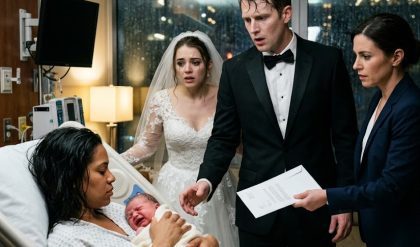
The night my father-in-law threw me and my six children into the storm, he thought he was ending my place in the Callahan family forever.
He stood under the glowing porch lights of the mansion, dry, warm, and cruel, while rain soaked through my coat and ran down my baby’s feverish face.
Then he shouted words that made every window in the house go silent.
“Only real family belongs under this roof.”
For one breath, I could not move.
Patrick Callahan’s voice sliced through the midnight rain like a blade. Behind him, the grand front doors of the Pine Valley estate stood open, spilling golden light onto the wet stone steps. Inside, relatives, neighbors, and old family friends watched from behind glass, their faces pale and curious, as if my children and I were not people—but a scandal unfolding for their entertainment.
My eleven-month-old daughter, Sophie, whimpered against my chest. Her tiny body burned with fever, her curls plastered to her cheeks. Behind me, my five older children huddled together in the storm, shivering in soaked pajamas and clutching school bags. Two black trash bags sat at their feet, stuffed with whatever clothes Margaret, my mother-in-law, had decided we deserved to keep.
My husband, Andrew, had been dead for only eight days.
Eight days since I held his hand in a hospital room and listened to the machines go quiet.
Eight days since my children stood beside his coffin, too young to understand how quickly grief could become homelessness.
Eight days since the Callahans stopped pretending they loved us.
“Patrick, please,” I said, forcing my voice not to break. “These are your grandchildren. This was Andrew’s home too.”
Margaret stepped forward in a cream shawl that probably cost more than my monthly grocery bill. Not one drop of rain touched her. Her face was calm, cold, and beautifully empty.
“It was Andrew’s home because we allowed it,” she said. “But you never belonged here, Cynthia. Marrying a Callahan didn’t make you one of us.”
My thirteen-year-old son, Benjamin, stepped beside me. His lips trembled, but his voice did not.
“Dad said Mom could stay here with us,” he said. “I heard him.”
Patrick’s head snapped toward him.
The look he gave my son was so sharp, so full of warning, that all my children froze.
And something inside me finally cracked.
“Do not threaten my son again,” I said quietly.
Patrick stared at me for a second, then laughed.
It was not a loud laugh. That made it worse.
“And what are you going to do, Cynthia?” he asked. “Fight us? With what money? What lawyer? What name?”
Margaret tossed another bag onto the ground. It split open at once. Tiny socks, sweaters, and one of Sophie’s blankets spilled into the mud.
My twins began to cry.
My daughters clung to my skirt.
Benjamin clenched his fists so tightly his knuckles turned white.
I looked up at the windows.
So many faces.
Relatives who had eaten at my table. Women who had kissed my children’s cheeks at Christmas. Men who had called Andrew their brother, cousin, friend.
Everyone watched.
No one moved.
For fourteen years, I had swallowed every insult for Andrew’s sake. I had endured Margaret’s little smiles, Patrick’s cold corrections, the whispers that I had married above myself. I had stayed quiet through birthdays they ignored, dinners where they corrected my grammar, and family photos where they pushed me to the edge of the frame.
But that night, with my children trembling in the rain, my silence died.
Because inside my diaper bag was a yellow folder.
Andrew had placed it in my hands three weeks before he died, his voice weak, his fingers cold around mine.
“If they ever try to force you out,” he had whispered, “find attorney Rebecca Stone. And don’t open this until that day comes.”
At the time, I thought grief had made him afraid.
Now I knew he had been preparing me.
Slowly, I reached into the bag.
Patrick’s smile faded.
Margaret’s eyes narrowed.
I pulled out the yellow folder, now damp at the corners, and held it against Sophie’s back.
“Before you celebrate,” I said, my voice carrying through the rain, “you should check who actually owns this house.”
Patrick went still.
For the first time all night, his confidence cracked.
Margaret’s lips parted, but no sound came out.
Behind the windows, every watching face changed.
Because the name written on that deed was not Patrick Callahan.
It was not Margaret.
And it was not even Andrew.
I looked Patrick straight in the eyes and said the name aloud.
PART 2
“Cynthia Rose Callahan.”
The name left my mouth softly, but it struck the mansion harder than thunder.
Patrick’s face twisted. “That is impossible.”
I held the yellow folder tighter against Sophie’s feverish body. “Andrew signed the transfer six months ago. The deed was changed legally. Rebecca Stone handled everything.”
Margaret staggered back as if the rain had finally touched her skin. “No,” she whispered. “Andrew would never give this house to you.”
“He didn’t give it to me,” I said, my voice shaking now, but not from fear. “He protected his children.”
Behind the glass, curtains shifted. Someone inside gasped. My son Benjamin looked up at me, hope cutting through the terror on his face.
Patrick stormed down one step. “Give me that folder.”
I stepped back.
At once, Benjamin moved in front of me.
He was only thirteen. Soaked, trembling, still wearing the black sweater from his father’s funeral. But in that moment, he stood like Andrew.
“Don’t touch my mother,” he said.
Patrick raised his hand.
Before he could bring it down, headlights swept across the driveway.
A black car rolled through the open iron gate and stopped behind us. The driver’s door opened, and a woman stepped out beneath a dark umbrella.
Rebecca Stone was taller than I remembered, dressed in a navy coat, her expression calm enough to frighten everyone.
“Mr. Callahan,” she said, walking toward the porch, “I strongly advise you not to assault a minor in front of witnesses.”
Patrick froze.
Margaret’s face drained of color.
Rebecca stopped beside me and looked at my children, then at the trash bags in the mud. Something hard flashed in her eyes.
“I came because Andrew instructed me to deliver the second envelope if this family attempted eviction.”
“The second envelope?” I whispered.
Rebecca reached into her coat and handed me a sealed white envelope with Andrew’s handwriting across the front.
For Cynthia, when they show you who they are.
My fingers trembled as I opened it.
Inside was one page.
I read the first line.
Then the second.
And by the time I reached the third, I understood why Patrick suddenly looked terrified.
Because Andrew had not only left me the house.
He had left me proof of what his parents had done the night before he died.
The paper in my hand felt heavy, damp with the mist of the unrelenting storm, but the words typed upon it were heavier still.
My eyes scanned the lines, written in the precise, unyielding font of a legal affidavit, accompanied by a transcription that turned my grief into something entirely different.
It turned my grief into a quiet, burning fury.
I looked up from the page, my gaze locking onto Patrick Callahan.
The man who had ruled this town, this family, and my husband’s life with an iron fist suddenly looked very small under the harsh golden glare of his own porch lights.
“What is that, Cynthia?” Patrick demanded, his voice trying to find its usual booming authority, but catching on a jagged edge of panic. “What did Andrew give you?”
“He gave me a record, Patrick,” I said, my voice no longer shaking.
“A record of the night before he died. The night you and Margaret paid a visit to the intensive care unit at 2:00 a.m., long after visiting hours had closed.”
Margaret’s hand flew to her mouth, her expensive cream shawl slipping slightly from her shoulders, exposing her to the cold spray of the wind.
“You don’t know what you’re talking about,” she stammered. “We went to say goodbye to our son.”
“No,” I said, taking a step up the stone stairs, pulling my six children up with me, closer to the warmth of the house they had just been evicted from.
“You didn’t go to say goodbye. You went with a notary. You went with a pen. And you went with a fraudulent corporate transfer document.”
The Recording in the Dark
Rebecca Stone stepped up beside me, her large black umbrella shielding my children from the biting rain.
She reached into her briefcase and pulled out a small, waterproof digital tablet, tapping the screen.
A high-definition audio file began to play, amplified through the sleek speakers of the device, cutting through the sound of the thunder.
The voice that filled the porch was weak, raspy, and punctuated by the steady, rhythmic beep of a heart monitor.
It was Andrew.
“Dad… please,” Andrew’s recorded voice breathed, thick with the heavy sedation of his final days. “Don’t make me sign this. The kids… Cynthia… they need the baseline shares to stay in the house. You promised.”
Then came Patrick’s voice, sharp, cold, and entirely devoid of a father’s love.
“You’re dying, Andrew. Let’s not be sentimental. Cynthia is a girl from the valley; she doesn’t understand the board. She’ll liquidate the shares and ruin the family name. Sign the transfer. If you don’t, I’ll ensure she doesn’t get a single cent of the insurance policy. I’ll tie her up in probate court until she’s living in a shelter.”
The recording continued, capturing the sound of shuffling paper, the frantic, shallow breathing of my dying husband, and Margaret’s voice chillingly adding:
“Just press his thumb to the ink pad, Patrick. He’s too weak to hold the pen anyway. The hospital administrator was taken care of; no one is logging this visit.”
The audio cut off with the harsh, agonizing alarm of the heart monitor spiking as Andrew’s distress grew too great for his failing body to bear.
The Silence of the Audience
The silence that settled over the Pine Valley estate was absolute.
Behind the massive floor-to-ceiling glass windows of the grand living room, the watching guests stood frozen.
The cousins, the investors, the local politicians who had all gathered for Patrick’s annual autumn gala had heard every single word.
The sound system inside the house had been linked to the external security feeds for the event—a feature Patrick had installed so he could make his grand entrance announcements.
Rebecca Stone had seamlessly patched the audio directly into the mansion’s internal network.
Patrick’s face turned an ugly, mottled purple.
“That is a manipulated recording!” he roared, pointing a trembling finger at Rebecca. “It’s inadmissible! It’s a violation of privacy!”
“Actually, Mr. Callahan,” Rebecca replied with a terrifyingly calm smile, “the intensive care unit room was legally registered under Cynthia’s sole name as the primary healthcare proxy. She gave prior written consent for all audio and visual monitoring within that room to protect her husband’s medical integrity. It is completely admissible. And it has already been filed with the federal district attorney.”
I took another step forward, standing on the threshold of the grand front doors.
My children stood tall behind me, their tears drying, replaced by the realization that their father had fought for them until his very last breath.
“You thought Andrew was weak, Patrick,” I said softly. “You thought because he was gentle, he was like you—willing to let people be crushed for the sake of a dollar. But he was smarter than you. He knew exactly what you would do the moment his heart stopped.”
Reclaiming the Fortress
I looked past Patrick and Margaret into the warm, opulent foyer.
The crystal chandeliers gleamed, reflecting off the polished marble floors.
This was the house where I had been forced to enter through the side door during family gatherings.
This was the house where my children were told not to touch the artwork because their clothes weren’t expensive enough.
“Benjamin,” I called out to my eldest son.
“Yes, Mom?”
“Take your sisters and brothers inside. Go to the kitchen, dry off, and tell the catering staff to prepare hot chocolate for all of you.”
Benjamin nodded, his chest swelling with pride. He grabbed the two black trash bags containing their clothes, held his sisters’ hands, and walked straight past his grandparents.
Patrick made a move to block the doorway, his hand reaching out to grab Benjamin’s shoulder.
“Don’t,” I warned, my voice striking like a whip. “You don’t have the legal authority to touch a single doorknob on this property anymore, Patrick. Get out of my way.”
For a second, I thought he might strike me. The sheer, unadulterated rage in his eyes was enough to make anyone step back.
But Rebecca Stone moved instantly, stepping between us with her tablet held high.
“The police are already at the bottom of the hill, Mr. Callahan,” she announced. “They are executing an emergency protection order and an immediate eviction notice against you and your wife. If you remain on these steps for another sixty seconds, you will be arrested for criminal trespass on property owned exclusively by the Cynthia Rose Callahan Trust.”
The Turning of the Internal Tide
Margaret began to panic, her perfect high-society poise shattering into jagged, ugly pieces.
“Patrick, do something!” she wailed, clutching his arm. “The guests… everyone is looking. Tell them to turn off the lights! Call our attorneys!”
“Our attorneys can’t save us from a signed, recorded deed that was registered before Andrew even went into the hospital, Margaret,” Patrick hissed, his voice cracking as the reality of his total defeat finally broke through his arrogance.
I walked past them, stepping into the warmth of the foyer. The heat hit my face, but it didn’t thaw the ice in my veins.
The guests inside had backed away from the doors, forming a wide, silent circle around me and my children.
These were the same people who, ten minutes ago, had looked out the window and watched a mother and six children get pushed into a torrential downpour without offering a single blanket.
I wiped a drop of rain from baby Sophie’s cheek. Her fever was still warm, but Rebecca had already called a private medical team to meet us inside.
I turned around to face the crowded ballroom.
“The gala is over,” I said clearly, my voice echoing through the vaulted ceilings of the mansion. “You may all leave through the western gates. And as you leave, remember the words my father-in-law said tonight.”
I paused, looking out at the sea of pale, ashamed faces.
“Only real family belongs under this roof. And it turns out, none of you qualify.”
The Sweep of the Ledger
Within twenty minutes, the mansion was entirely empty of its high-society parasites.
The expensive cars cleared out of the winding driveway like a line of black ants fleeing a flooded nest.
Patrick and Margaret were escorted down the stone steps by two local sheriff’s deputies, left to stand in the very rain they had thrown my children into, waiting for a taxi because Rebecca had already revoked their corporate car privileges.
I sat in the grand library, a fire crackling in the hearth.
Sophie was wrapped in a dry, warm blanket, sleeping peacefully after receiving medication from the doctor Rebecca had brought.
My other five children were gathered around the massive mahogany table, drinking hot chocolate and wrapped in oversized velvet throws.
Rebecca sat opposite me, opening a thick blue binder.
“Andrew didn’t just save the house, Cynthia,” she explained, her eyes soft with admiration for the man we both missed.
“The Callahan Enterprises corporate charter states that whoever holds the physical deed to the founding estate holds the primary voting block for the executive board. It’s an old, traditional clause Patrick put in decades ago to ensure he could never be ousted from his own company.”
I looked up from Sophie’s sleeping face. “Meaning?”
“Meaning that by transferring this house to you, Andrew didn’t just protect your shelter,” Rebecca said, a slow, triumphant smile appearing on her face.
“He gave you fifty-one percent control of the entire Callahan financial portfolio. Tomorrow morning at 9:00 a.m., you aren’t just the owner of this house, Cynthia. You are the chairperson of the board.”
The Morning of the Sovereign
The storm passed by dawn, leaving behind a crisp, brilliant autumn morning. The sun broke through the heavy gray clouds, painting the valley in shades of gold and amber.
At exactly 8:45 a.m., a sleek silver sedan pulled up to the front steps of the mansion.
I stood on the porch, wearing a sharp, tailored black suit that had belonged to my mother, my hair pulled back into a neat, unyielding bun.
Benjamin stood beside me, wearing his father’s old watch, his eyes bright with a maturity that had been forged in the fire of the previous night.
“Are you ready, Mom?” he asked.
“I’ve been ready for fourteen years, Ben,” I replied.
We drove to the corporate headquarters of Callahan Enterprises—a towering glass monolith downtown that bore the family name in giant, silver letters.
When I walked through the front doors, the lobby fell instantly quiet. The receptionists, the security guards, the executives who had previously ignored my existence or treated me like a charity case stared in absolute shock.
I didn’t take the guest elevator. I took the private executive lift straight to the top floor.
When the doors opened to the boardroom, Patrick and Margaret were already there, flanked by a team of expensive corporate lawyers in gray suits.
Patrick looked exhausted, his clothes wrinkled, his eyes bloodshot, but his jaw was still set in that familiar, stubborn line of defiance.
“You can’t do this, Cynthia,” Patrick said, slamming his hand onto the glass conference table as I walked in. “You don’t know anything about logistics, about development, about international trade. You’re a schoolteacher. You’ll tank the stock within a week.”
The New Management
I didn’t sit down in the chair at the foot of the table. I walked straight to the head of the room, where Patrick’s nameplate sat in a heavy crystal holder.
I picked up the nameplate, handed it to Rebecca without looking at it, and sat down in the leather captain’s chair.
“I may be a schoolteacher, Patrick,” I said, leaning forward and resting my hands flat on the table.
“But I know how to handle unruly, undisciplined children who think they can break the rules without consequences.”
I nodded to Rebecca, who distributed a single-page document to every lawyer in the room.
“This is a formal motion for the immediate suspension of Patrick Callahan and Margaret Callahan from all corporate operations, effective immediately,” I announced.
“We are launching a full independent forensic audit into the offshore accounts used to facilitate the bribery of the hospital staff on the night of October 12th. Furthermore, we are turning over all audio recordings and corresponding digital metadata to the state prosecutor for charges of attempted grand larceny and elder abuse.”
Patrick’s lead attorney scanned the document, his face turning pale within seconds. He leaned over and whispered into Patrick’s ear.
Patrick’s eyes widened in horror. He looked at his own lawyer, hoping for a contradiction, but the man simply shook his head and closed his briefcase.
“This is an airtight corporate execution, Mr. Callahan,” the lawyer muttered under his breath. “There is nothing to defend. She has the votes, she has the deeds, and she has the criminal evidence.”
The Legacy of the Invisible
Patrick sank back into his chair, the last remaining breath of his empire leaving his lungs in a long, defeated sigh.
Margaret looked at him, then at me, her eyes filling with real, genuine terror for the first time in her life.
“Where are we supposed to go?” she whispered, her voice cracking. “Our accounts… our home… everything is tied to the estate.”
“You can go wherever the rain takes you, Margaret,” I said smoothly, mirroring the exact tone she had used on me the night before.
“But you won’t be staying under my roof. And you won’t be using my husband’s money to buy your shawls anymore.”
I stood up, signaling the end of the meeting.
The lawyers began to file out, leaving Patrick and Margaret sitting alone at the long, empty table.
They looked small, withered, and entirely drained of the cruelty that had sustained them for so many years.
I walked out of the boardroom and down the long glass corridor, my high heels clicking firmly against the polished tile.
With every step, I felt the phantom weight of fourteen years of insults, fourteen years of being pushed to the edge of the frame, fourteen years of being told I wasn’t enough, completely evaporate from my shoulders.
I wasn’t a shadow anymore.
I was the fortress.
And as I looked out the window at the valley below, I knew that my children would never have to stand in the cold rain again, because their father had built them a shelter that no one on earth could ever take away.
The end