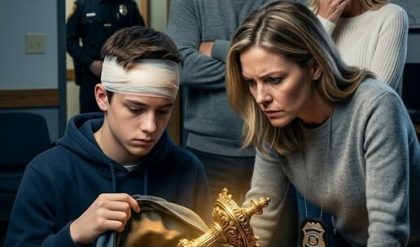
Eight days after I gave birth, I was bl:eeding in the baby’s room while my husband zipped up his suitcase and said, “Stop ruining my birthday.” He came back sunburned, only to find the dried truth on the carpet and lose his family forever in front of everyone at court.
“If you’re bl:eeding that badly, put a towel on it and stop ruining my birthday.”
That was the last thing Tyler said to me before zipping up his suitcase.
I was sitting on the floor of our baby’s room, one hand gripping the edge of the crib and the other pressed against my stomach, still swollen from childbirth. Parker had been born eight days earlier. Eight days without sleep. Eight days of pain, milk stains soaking through my robe, and fear every time I breathed a little too fast.
But that afternoon it wasn’t exhaustion.
It was bl00d.
Too much bl:ood.
The cream-colored carpet my mother-in-law had chosen “to make the nursery look elegant” already had a dark red stain spreading beneath my legs. I stared at it in disbelief, unable to understand how something so serious could happen inside a house that felt so quiet.
“Tyler, please,” I said, trying to raise my voice. “I need to go to the hospital. I feel really weak.”
He walked out of the closet wearing sunglasses pushed up on his head and a brand-new white shirt, looking as if he were heading to a photo shoot.
“Here we go again,” he muttered. “My mom told me all women bleed after giving birth. You’re not the first woman in the world to have a baby.”
“This isn’t normal,” I insisted. “I’m getting dizzy.”
Tyler didn’t even come closer. He stayed by the door, staring down at his phone.
“Look, Olivia, I paid a fortune for this weekend in Blue Ridge Mountains. Cabin with a jacuzzi, private dinner, my friends are already on the way. I’m not canceling because you want attention.”
The word “attention” hurt more than the cramping tearing through my back.
Parker began crying in his bassinet. A tiny, desperate cry, as if he understood something was terribly wrong too. I tried turning toward him to pick him up, but my arms wouldn’t respond. The room tilted.
“Call my mom,” I begged. “Call an ambulance. Anything.”
Tyler laughed bitterly.
“An ambulance? So everyone can say I’m the bad guy because I left to celebrate? No thanks. Drink some tea. My mom will come tomorrow.”
“I won’t make it until tomorrow,” I whispered.
For the first time, he looked at the floor. He saw the bl00d. Really saw it. His face changed for half a second, but then his jaw tightened, as though admitting fear would somehow humiliate him.
“You always exaggerate,” he said. “You’ve been dramatic about everything since the pregnancy.”
He walked past me. His shoe nearly touched the stain.
I reached out and grabbed the bottom of his pant leg.
“Tyler, look at me. Please.”
He yanked himself free.
“Stop trying to manipulate me. It’s my thirtieth birthday and I deserve some peace.”
From the front door he shouted:
“I’m putting my phone on airplane mode. I don’t want any crying messages.”
Then the door slammed shut.
I heard his truck engine fading down the private street in Franklin. Outside, life continued as usual. Dogs barked. A neighbor watered plants. Someone played music in the distance.
Inside, my son was crying and I could no longer move.
I tried reaching for my phone on the dresser. My fingertips brushed the case, but the phone slipped and fell onto the floor, lighting up in front of my face.
A notification appeared.
Tyler posted a story: “On the way to Blue Ridge. Meat, whiskey, friends, and zero drama.”
The photo showed his hand on the steering wheel, his new watch shining, the highway stretched open before him as though he were escaping from a prison.
Meanwhile, I was lying on the floor beside his son’s crib.
And the worst part hadn’t even happened yet.
PART 2
I woke up to my mother’s voice screaming my name.
For a second, I thought I was still on the nursery floor, trapped inside that quiet, terrible room while Parker cried above me. Then white lights blurred overhead, machines beeped beside my bed, and a nurse pressed a cool hand against my shoulder.
“Olivia, don’t move.”
My mother stood near the door with Parker bundled in her arms, her face gray with shock. “I came because you didn’t answer my calls,” she whispered. “The front door was unlocked. The carpet…”
She couldn’t finish.
The doctors said another hour might have killed me.
Tyler did not answer until the next evening.
By then, the hospital had documented everything: the emergency surgery, the blood loss, the stained robe sealed in a plastic bag, the nursery photographs my mother took before the cleaners came. Even Tyler’s post was saved before he deleted it.
When he finally walked into my hospital room, sunburned and smelling like smoke and whiskey, he looked annoyed before he looked afraid.
“Why is everyone acting like I abandoned you?” he snapped. “You should’ve called someone else.”
My mother stepped between us. “She begged you.”
His eyes shifted to Parker. “Give me my son.”
I laughed then, weak and broken, but still loud enough to stop him.
“Your son?” I whispered. “You left him crying beside me while I bled on the floor.”
Tyler’s face hardened. “You’re emotional. No court is going to take a newborn from his father because his wife had a dramatic postpartum episode.”
Three months later, he learned how wrong he was.
The courtroom was packed with his parents, his friends, even the men from his birthday trip who had come to support him. Tyler wore a navy suit and practiced sadness like a performance.
Then my lawyer played the recording.
My phone had been on the nursery floor that day, still recording a voice memo I had started to track Parker’s feeding times. Tyler’s words filled the courtroom clearly.
“Put a towel on it and stop ruining my birthday.”
His mother began crying. One of his friends looked down.
The judge didn’t.
Then my lawyer opened one final envelope and said, “Your Honor, there is another reason Mr. Hayes should never be left alone with this child.”
Tyler stood so fast his chair fell backward.
The courtroom grew so silent you could hear the hum of the fluorescent lights humming overhead.
Tyler stood frozen. His hands gripped the mahogany table in front of him, his knuckles turning a stark, bloodless white.
The chair he had knocked over lay on its side behind him, a heavy piece of furniture that had crashed down like a gavel of his own making.
“Your Honor, this is irrelevant!” Tyler’s lawyer shouted, scrambling to his feet, his face flushed with sudden panic. “The custody hearing is about parental fitness as it relates to the separation. Whatever counsel is trying to introduce—”
“Sit down, Mr. Vance,” Judge Evelyn Thomas said. Her voice wasn’t loud, but it possessed the kind of weight that cut through the room like a blade.
She didn’t look at the lawyer. She looked directly at Tyler.
Her eyes were cold, ancient, and completely devoid of mercy.
I sat at my own table, my fingers tightly interlaced with my mother’s beneath the wood. My mother was holding Parker outside in the hallway with a court-appointed advocate, keeping him away from the poison of this room.
But I was here.
I was here, wearing a black suit that felt too big for my shrunk, postpartum frame.
I was here, no longer bleeding, no longer begging.
My attorney, Clara Martinez, stepped forward. She didn’t look at Tyler either. She didn’t need to. He was already shrinking, even as he stood there trying to look large and imposing.
“Your Honor,” Clara said, her voice steady and echoing in the high-ceilinged room. “The defense has spent the last three months claiming that my client, Olivia Hayes, suffered from severe postpartum psychosis. They have alleged that she hallucinated the severity of her medical emergency. They have claimed she is an unfit, unstable mother who tried to ruin her husband’s milestone birthday out of spite.”
Clara reached into the thick manila envelope.
“But we have already disproven that with the voice recording,” Clara continued, gesturing to the laptop on the cart, where Tyler’s voice still seemed to linger in the air like carbon monoxide.
“Put a towel on it and stop ruining my birthday.”
The words had played less than two minutes ago.
They had cut through the lies Tyler’s mother, Evelyn, had told on the stand just an hour prior—how Tyler was “a devoted family man,” how Olivia was “always fragile,” how the cream carpet she bought was “ruined by carelessness.”
But the recording was only the first layer of the grave Tyler had dug for himself.
“What I am introducing now,” Clara said, pulling out a stack of financial documents and a certified medical report from an independent clinic in Atlanta, “is evidence of a premeditated, calculated effort to endanger both Olivia Hayes and their newborn son, Parker.”
Tyler’s mother gasped from the second row of the gallery.
Tyler’s father, a man who had made his fortune in commercial real estate and had bought Tyler his truck, his watch, and his arrogance, closed his eyes.
“What is that, Clara?” I whispered, my voice trembling. Even I didn’t know what was in this final envelope. Clara had told me to trust her, that she had dug into the discovery files until her fingers bled.
Clara turned her head slightly to look at me, a fierce, protective light in her eyes.
“This,” Clara announced to the judge, “is the medical insurance cancellation notice for Olivia Hayes. Signed by Tyler Hayes. Dated exactly three weeks before Parker was born.”
The courtroom erupted into a low murmur.
“Quiet!” the bailiff barked.
I felt the air leave my lungs.
My mind raced back to the hospital. The white lights. The emergency room. The doctors screaming for units of O-negative blood.
I remembered the days after, when the billing department kept coming into my recovery room, looking uncomfortable, asking if there had been a glitch with our premium payments.
Tyler had told me it was a clerical error. He said his company’s HR department was handling it. He told me to stop stressing because “stress ruins the milk supply, Olivia.”
“Furthermore,” Clara said, her voice rising above the murmurs, “we have the subpoenaed search history from Mr. Hayes’s personal laptop and phone. Six weeks before the birth, Mr. Hayes frequently searched for terms such as: ‘How to file for full custody if mother is medically incapacitated,’ ‘Postpartum depression custody laws Georgia,’ and ‘Can a father get sole custody if mother has a history of mental illness?'”
Clara dropped the papers onto the judge’s desk with a sharp thud.
“Tyler Hayes did not just leave his wife to bleed on a carpet because he wanted to drink whiskey in the mountains, Your Honor,” Clara said, turning to face Tyler directly.
“He left her there to die.”
“He wanted her incapacitated. He wanted to claim she was unstable from the moment she fell pregnant, so he could take the child, claim the trust fund left to Parker by Olivia’s late grandfather, and rid himself of a wife he no longer desired without paying a single cent of alimony.”
The silence returned, heavier this time.
It was a silence built of horror.
Tyler’s friends—the men who had been in the Blue Ridge cabin, the men who had posted pictures of him holding a glass of bourbon while I lay on a tiled floor losing half the blood in my body—looked away.
One of them, a guy named Marcus who had known Tyler since college, stood up quietly, slid out of his row, and walked out of the courtroom.
He didn’t look back.
Tyler looked at his mother. But Evelyn Hayes was staring at the floor, her manicured hands covering her face, her shoulders shaking. She was a woman obsessed with appearance, and her son had just been exposed as a monster in front of the county’s elite.
“Mr. Hayes,” Judge Thomas said. Her voice was terrifyingly calm. “Sit down.”
Tyler didn’t move.
“Sit down, sir,” the judge repeated, her tone dropping an octave.
Tyler sank into his chair. The arrogance that had sustained him for thirty years, the wealth that had shielded him from every consequence, seemed to evaporate. He looked small. He looked like the coward he was.
“We are going to take a fifteen-minute recess,” Judge Thomas said, standing up. “When I return, I will deliver my ruling on custody, support, and I will be making a formal referral to the District Attorney’s office for criminal neglect and reckless endangerment.”
She slammed her gavel down.
The sound was like a gunshot.
In the hallway, the air felt cooler, cleaner.
My mother was sitting on a wooden bench, rocking Parker. He was awake, his large, dark eyes looking up at the ceiling lights, his tiny fists batting at the air. He was healthy. He was safe.
When my mother saw my face, she stood up quickly.
“Olivia? What happened? What did they say?”
I couldn’t speak at first. I walked over and took my son into my arms.
He smelled of baby powder and milk. He was warm. Eight days after he was born, I couldn’t hold him because my body was failing, because the man who promised to love me had stepped over my blood to go to a party.
But today, I held him tight.
“He lost, Mom,” I whispered, burying my face in Parker’s soft hair. “He lost everything.”
Clara walked out of the courtroom, her briefcase slung over her shoulder, a satisfied, tired smile on her face.
“The judge is signing a temporary emergency order,” Clara said. “Full legal and physical custody to you. Supervised visitation is denied. Tyler isn’t allowed within five hundred feet of either of you. And the financial freezing order is being processed. He won’t be able to touch a dime of his assets until the criminal investigation is completed.”
My mother let out a sob, covering her mouth. “Thank God. Oh, thank God.”
But as we stood there, the heavy double doors of the courtroom swung open again.
Tyler walked out.
His tie was loosened, his jacket was unbuttoned, and his face was a mask of pure, unadulterated rage. His parents were behind him, trying to hold him back, but he pushed past them.
He saw me holding Parker.
“You think you won?” Tyler shouted, his voice echoing off the marble walls of the courthouse. Several security guards immediately began moving toward him.
“You ruined my life, Olivia! You and your mother! You trapped me with this kid, you ruined my birthday, and now you’re trying to put me in jail?!”
He tried to take a step toward me, his eyes wild.
“You’re a liar!” he screamed. “That recording was taken out of context! You were fine! You were always fine!”
I didn’t step back.
Three months ago, I was on my knees, pulling at his pant leg, begging him for a crumb of humanity. I had felt so small, so entirely at his mercy.
But looking at him now, surrounded by guards, his face red and sweating, his family crumbling behind him, I realized something.
He had never been strong. He had only been loud.
“I wasn’t fine, Tyler,” I said. My voice didn’t shake. It was the loudest sound in the hallway. “I was dying. And you knew it.”
“Get away from her!” one of the guards yelled, grabbing Tyler’s arm and twisting it behind his back.
“Get your hands off me! Do you know who my father is?!” Tyler roared, struggling against the grip.
His father, Arthur Hayes, walked past his son without looking at him. He approached me, his face pale, his posture broken.
“Olivia,” Arthur said, his voice old and cracked. “I’m sorry. We didn’t know. We didn’t know he was… that he did that to you.”
“You chose the carpet, Arthur,” I said coldly. “Your wife told him that women just bleed. You built the house he felt safe leaving me to die in. Don’t look for forgiveness here.”
Arthur opened his mouth to speak, but no words came out. He turned around, took his wife’s arm, and walked toward the elevators, leaving their only son to be escorted out of the building in handcuffs for violating a court decorum order and resisting the guards.
We walked out of the courthouse into the bright, warm afternoon sun.
The air in Franklin was sweet, filled with the scent of summer and pine trees from the nearby hills. It was the same air Tyler had driven off to enjoy three months ago while I lay on the floor.
We got into my mother’s car. I buckled Parker into his car seat, checking the straps three times, making sure he was perfectly secure.
As my mother drove us away from the square, past the historic brick buildings and the manicured lawns, I looked out the window.
I knew the road ahead wouldn’t be easy. There would be more court dates, a criminal trial, and the long, slow process of healing a body and a mind that had been pushed to the absolute brink of death.
The cream-colored carpet in the nursery had already been ripped out. Underneath, the wooden floorboards had been scrubbed clean.
Tomorrow, I was going to paint the walls a bright, soft blue.
I looked back at Parker. He had fallen asleep, his tiny mouth slightly open, his chest rising and falling in a peaceful, steady rhythm.
The drama was over.
The truth had dried, it had been seen, and now, finally, we were free.
The end