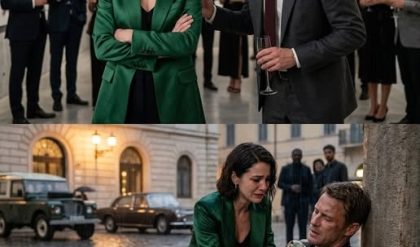
The bride humiliated his mother in front of three hundred wedding guests, then learned why even monsters still kneel for the women who raised them
The champagne flute shattered before anyone screamed.
It hit the Italian marble with a sharp, musical ping, then burst into silver fragments under the glow of the chandeliers. Champagne hissed across the floor. Red wine splashed like blood over the white silk of Vivienne Hartwell’s wedding gown.
For one frozen second, the ballroom at the Fairmont Harbor Club in Boston looked less like a wedding reception and more like a crime scene.
Then Vivienne looked down at the stain spreading across her custom dress and shrieked, “Look what you did!”
No one moved.
Not the senators. Not the judges. Not the men in black suits standing near every exit. Not the twelve-piece jazz band that had been playing soft Sinatra covers moments earlier.
And not Rosa Rossi, the small, trembling woman on the floor, clutching her wrist beside a broken tray of champagne glasses.
Vivienne stood over her in white silk, diamonds, and fury.
“This dress costs more than your entire life,” she snapped, her voice echoing through the ballroom. “Keep your cheap, filthy garbage away from me, you clumsy old peasant.”
That was the moment Vivienne Hartwell stopped being a bride.
And became a warning.
Six hours earlier, she had walked down the aisle with a smile so perfect it looked manufactured.
The aisle had been covered in white roses flown in from California. The ceiling glittered with chandeliers. The string quartet played with the kind of fragile elegance money could buy but never truly own. Every guest had stood when she appeared.
Vivienne knew she looked flawless.
Her Vera Wang gown fit like a second skin, the bodice tight enough to make breathing a negotiation. Her blond hair had been swept into a soft, elegant knot. Her makeup was understated in the way only a four-hundred-dollar-an-hour artist could make it. Around her neck rested borrowed diamonds from her mother’s collection, though everyone knew the Hartwell collection was not what it used to be.
That was why she was here.
That was why she had said yes.
Her father, Richard Hartwell, had once owned half the luxury real estate along the Massachusetts coast. He had golfed with governors, donated to hospitals, and smiled on magazine covers beside his quietly miserable wife.
Then the loans collapsed.
Then the shell companies failed.
Then the bank began circling the Hartwell estate in Manchester-by-the-Sea like a wolf outside a glass house.
And then Gabriel Rossi appeared.
He was not the kind of man Vivienne had imagined marrying.
He was too quiet. Too watchful. Too broad through the shoulders. Too calm for someone everyone whispered about. His family owned restaurants, private security firms, construction companies, and shipping contracts along the East Coast.
On paper, Gabriel Rossi was a businessman.
In Boston, everyone knew better.
Vivienne’s father called him “a difficult man with useful connections.”
Her mother called him “a necessary unpleasantness.”
Vivienne called him nothing at all.
She simply avoided looking too closely at the blood beneath the polished shoes.
Gabriel had cleared her father’s worst debts, stopped two lawsuits from becoming public, and kept the Hartwell name from becoming a headline. In exchange, Vivienne had become the bridge between old money and dangerous money.
A Hartwell bride for a Rossi empire.
A silk ribbon tied around a loaded gun.
At the altar, Gabriel had looked at her without softness but without cruelty.
“Vivienne,” he said when it was time for his vows, “I protect what is mine.”
The guests mistook it for romance.
Vivienne heard the lock click shut.
By the time the reception began, her ribs ached from the gown’s corset. Her feet were raw inside satin heels. Her smile had become a painful mask. Men with thick necks and expensive watches kissed both her cheeks. Women in black designer dresses studied her like she was a chandelier purchased for the wrong room.
Gabriel’s people.
The Rossi family.
They called each other cousin whether they shared blood or secrets. They kissed loudly. They laughed from the belly. They ate too much. They spoke in rough, fast bursts of Italian when they forgot to impress the polite society guests.
Vivienne hated them.
She hated the smell of cigar smoke clinging to their jackets. She hated their gold chains. She hated their wives’ heavy perfume. She hated the way they looked at Gabriel with a loyalty that bordered on worship.
Most of all, she hated that she needed them.
Gabriel spent most of the evening near the mahogany bar, listening to a city councilman whisper urgently into his ear. He held a tumbler of bourbon loosely, his black tuxedo tailored to perfection. He had not checked on her in over an hour.
That irritated her more than she wanted to admit.
She was used to being watched.
Admired.
Envied.
Tonight, she was simply seated at the center of his table like an expensive centerpiece.
Then the crowd parted.
And Rosa Rossi walked toward her.
Gabriel’s mother looked painfully out of place beneath the crystal chandeliers. She was short and round, with stooped shoulders and careful steps. Her dark plum dress was plain, the kind of thing a woman might buy on sale at a department store and save for church. Her gray hair was pulled into a tight bun, exposing deep lines around her mouth and eyes.
She carried a small velvet box in both hands.
Vivienne felt her jaw tighten.
She had met Rosa twice before. Both times, the woman had tried too hard. She had brought homemade cookies to the Hartwell estate in a tin container. She had called Vivienne “beautiful girl” in a thick Sicilian accent. She had touched Vivienne’s arm as if affection could be handed over like a napkin.
Vivienne had found her embarrassing.
Now Rosa stopped before the head table and offered a nervous smile.
“Vivienne,” she said softly. “For you. Welcome to family.”
She opened the box.
Inside was a necklace.
Not diamonds. Not pearls. Not anything Vivienne would have chosen.
It was heavy old gold, tarnished at the edges, with a dark red stone set in the center. The chain looked ancient. The pendant looked like something pulled from a drawer in a grandmother’s apartment, smelling of old paper and mothballs.
Vivienne’s stomach twisted.
“My grandmother,” Rosa said, lifting it with arthritic fingers. “She bring this when she come to America. Hide it in coat lining. I wear when I marry Gabriel’s father. Now you wear.”
Vivienne stared at it.
The necklace was not a gift.
It was a claim.
A collar.
A symbol that she belonged now not to the Hartwells, not to Beacon Hill, not to summer houses and charity galas, but to these people. To this loud, brutal family. To a mother with cracked hands and a clearance-rack dress.
“Oh,” Vivienne said, forcing sweetness into her voice. “It’s very old. Thank you, Rosa. I’ll have one of the maids put it somewhere safe.”
Rosa shook her head, confused by the polite dismissal.
“No, no. You wear now. For family.”
Before Vivienne could lean away, Rosa stepped closer. Her rough fingers brushed Vivienne’s collarbone as she tried to bring the chain around her neck.
The cold metal touched Vivienne’s skin.
A thread of lace snagged.
Something inside Vivienne snapped.
It was not just the necklace. It was the dress cutting into her ribs. The humiliation of her father’s desperation. The way Gabriel’s world had swallowed hers whole. The fear she had hidden beneath perfect lipstick and diamond earrings.
“Don’t touch me,” she hissed…
Part 2: Then she slapped Rosa’s hands away.
Hard.
Too hard.
Rosa stumbled backward. Her heel caught on the edge of the carpet. She fell into a passing waiter carrying a tray of champagne and red wine.
Glass exploded.
The room went silent.
Vivienne’s first thought was not that Rosa had fallen.
It was that the wine had hit her dress.
Then came the scream.
“Look what you did!”
Rosa was still on the floor, trembling, one hand pressed to her wrist. A thin line of blood slid down her forearm where broken glass had cut her skin.
Vivienne barely saw it.
“This dress costs more than your entire life,” she snapped. “Keep your cheap, filthy garbage away from me, you clumsy old peasant.”
Three hundred people heard her.
The jazz band stopped.
The waiters froze.
Her father went pale.
And at the far end of the ballroom, Gabriel Rossi slowly turned his head.
He did not run.
He did not shout.
That was the first thing that frightened Vivienne.
He set his bourbon down on the bar with careful precision. Then he walked toward the head table. Men stepped aside before he reached them. Women lowered their eyes. Even the politicians seemed suddenly interested in the floor.
Gabriel knelt in the broken glass beside his mother.
He did not look at Vivienne.
Not once.
“Mamma,” he murmured, his voice low and gentle in a way Vivienne had never heard before.
Rosa began to cry.
Gabriel pulled a linen handkerchief from his pocket and pressed it against her bleeding arm. He spoke to her in Italian, soft and fast. Rosa shook her head, embarrassed, and pointed toward the necklace lying in a puddle of wine.
Gabriel picked it up.
He wiped the red stone with his thumb.
Then he helped his mother stand…
Gabriel Rossi helped his mother to her feet.
The ballroom remained silent.
Three hundred guests watched as Rosa Rossi stood trembling beside her son, a hand pressed against the blood seeping through the linen handkerchief wrapped around her wrist.
Vivienne expected shouting.
She expected rage.
She expected the terrifying stories whispered about Gabriel Rossi to become reality.
Instead, he did something worse.
He looked disappointed.
Not in the way a husband looks at a wife.
In the way a man looks at a stranger who has revealed exactly who they are.
“Mamma,” he said quietly, “are you hurt?”
Rosa shook her head immediately.
It was clearly a lie.
“I’m fine.”
Her voice trembled.
Gabriel nodded once.
Then he removed his tuxedo jacket and draped it over her shoulders.
Only then did he finally look at Vivienne.
The entire room seemed to stop breathing.
Vivienne had spent months convincing herself she understood her new husband.
She realized now that she never had.
Because the expression on his face contained no anger.
No humiliation.
No embarrassment.
Only certainty.
The certainty of a man who had just reached a conclusion.
“You pushed her.”
His voice was calm.
Vivienne straightened her shoulders.
“She ruined my dress.”
Several guests winced.
Even now, she thought the dress mattered.
Gabriel glanced at the wine stain spreading across the silk.
Then he looked at the blood on his mother’s wrist.
“I see.”
Nothing more.
Just those two words.
But suddenly they sounded like a verdict.
Across the room, Richard Hartwell felt cold terror crawling through his chest.
He knew men like Gabriel Rossi.
Not from newspapers.
From private meetings.
From desperate negotiations.
From years spent borrowing money and influence from people whose smiles never reached their eyes.
Richard understood something his daughter did not.
The most dangerous men rarely raised their voices.
And Gabriel Rossi had become very quiet.
“Gabriel,” Richard said nervously, stepping forward. “Let’s not overreact. Emotions are running high.”
Gabriel turned his gaze toward him.
Richard immediately wished he hadn’t spoken.
“Overreact?”
The word hung in the air.
“No,” Gabriel said. “I don’t believe anyone is overreacting.”
Rosa touched her son’s arm.
“Gabriel.”
He looked down.
The hardness in his face softened instantly.
“Take me home,” she whispered.
The entire Rossi family looked stunned.
Because Rosa never asked for anything.
Never.
She had spent forty years putting everyone else first.
Working.
Cooking.
Sacrificing.
Forgiving.
And now she wanted to leave.
Gabriel nodded.
“Of course.”
He turned toward the crowd.
“Ladies and gentlemen.”
His voice carried effortlessly through the ballroom.
“Thank you for attending.”
Nobody moved.
Nobody spoke.
Then Gabriel did something nobody expected.
He walked to the head table.
Picked up the microphone.
And told the truth.
“My mother arrived in America when she was seventeen.”
The room fell completely silent.
“She spoke almost no English.”
Rosa lowered her eyes.
Gabriel continued.
“She worked in factories.”
“Cleaned offices.”
“Packed boxes.”
“Worked double shifts.”
“Sent money home.”
“Raised children.”
He looked around the ballroom.
At senators.
Judges.
Investors.
Business leaders.
“Everything I own began with her sacrifice.”
His voice remained calm.
“Every company.”
“Every building.”
“Every dollar.”
“My mother built the foundation.”
The silence deepened.
Because everyone understood.
This wasn’t about the wedding anymore.
This wasn’t about the dress.
This was about something far older.
And far more important.
Gabriel lifted the tarnished necklace.
The one Rosa had brought.
The one Vivienne had rejected.
“You see an old necklace.”
He held it up.
“My grandmother carried this through a war.”
The room listened.
“She hid it inside her coat when soldiers searched refugees.”
“She crossed an ocean with it.”
“She sold everything else.”
“Not this.”
His thumb brushed the red stone.
“When my grandfather had nothing, she sold her wedding ring but kept this necklace.”
“When my father died, my mother wore it.”
“When I buried my father, she wore it.”
The room was silent.
Some guests looked away.
Ashamed.
Because suddenly the necklace was no longer jewelry.
It was history.
Memory.
Love.
Survival.
Vivienne felt something unfamiliar.
Not anger.
Fear.
Real fear.
Because for the first time, nobody was looking at her dress.
Nobody cared about the stain.
Nobody cared about the wedding.
They were looking at her.
And they did not like what they saw.
Then Rosa spoke.
Quietly.
“Gabriel.”
He turned.
“I don’t want revenge.”
The room listened.
Rosa smiled sadly.
“I am too old for revenge.”
Tears filled her eyes.
“I only wanted a daughter.”
Something broke inside the ballroom.
Not physically.
Emotionally.
Because there was no cruelty in Rosa.
No manipulation.
No performance.
Just heartbreak.
She had genuinely wanted to welcome Vivienne.
And Vivienne had humiliated her.
For the first time that night, Vivienne couldn’t speak.
The words wouldn’t come.
She remembered the cookies.
The nervous smiles.
The invitations.
The attempts.
All the moments she had dismissed as embarrassing.
All the kindness she had mistaken for weakness.
And suddenly she saw them differently.
Gabriel helped his mother toward the exit.
The Rossi family followed.
One by one.
Not dramatically.
Not angrily.
Simply leaving.
Loyal.
Protective.
United.
The powerful politicians remained seated.
The businessmen remained silent.
Nobody tried stopping them.
Because everybody understood.
The wedding reception was over.
Not officially.
Spiritually.
When Gabriel reached the ballroom doors, he paused.
Without turning around, he spoke.
“Money can buy influence.”
The room listened.
“Fear can buy obedience.”
His voice remained steady.
“But respect?”
He shook his head slightly.
“Respect must be earned.”
Then he left.
The weeks that followed changed everything.
The story spread quietly through Boston society.
Not because of gossip.
Because witnesses couldn’t stop talking about it.
About the mother.
About the necklace.
About the silence.
About the son who knelt in broken glass before he spoke a single angry word.
Vivienne returned to the Hartwell estate.
The mansion felt emptier than ever.
The mirrors seemed crueler.
The rooms colder.
For the first time in her life, she was forced to sit alone with herself.
And she discovered something painful.
The people she looked down on had often possessed qualities she lacked.
Loyalty.
Humility.
Gratitude.
Love.
Three months later, she drove to a small house on the edge of Boston.
No reporters.
No photographers.
No designer clothes.
Just a simple black coat.
And the necklace in her hands.
Rosa opened the door herself.
The older woman looked surprised.
Neither spoke immediately.
Finally, Vivienne held out the necklace.
“I’m sorry.”
The words felt inadequate.
Tiny.
But they were true.
Rosa stared at her.
Then smiled sadly.
“Come inside.”
Forgiveness did not happen instantly.
Trust did not magically return.
Some wounds require time.
Some mistakes leave scars.
But for the first time, Vivienne stopped trying to be admired.
She started trying to become better.
And that made all the difference.
Because in the end, the lesson was never about a wedding.
Or a necklace.
Or even a marriage.
It was about understanding a truth many people learn too late:
The strongest men in the world may command armies, businesses, and fortunes.
But the best of them never forget the women who taught them how to stand.
And when those women are hurt, even the most feared men will kneel.
The End