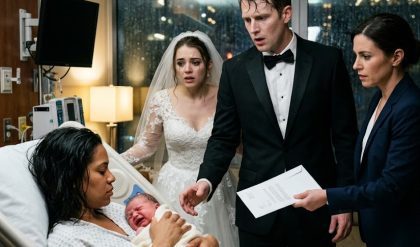
My Husband Left Me Bleeding After Childbirth to Celebrate His Birthday — He Returned Sunburned and Lost Everything in Court
“If you’re bl:eeding that badly, put a towel on it and stop ruining my birthday.”
That was the last thing Tyler said to me before zipping up his suitcase.
I was sitting on the floor of our baby’s room, one hand gripping the edge of the crib and the other pressed against my stomach, still swollen from childbirth. Parker had been born eight days earlier. Eight days without sleep. Eight days of pain, milk stains soaking through my robe, and fear every time I breathed a little too fast.
But that afternoon it wasn’t exhaustion.
It was bl00d.
Too much bl:ood.
The cream-colored carpet my mother-in-law had chosen “to make the nursery look elegant” already had a dark red stain spreading beneath my legs. I stared at it in disbelief, unable to understand how something so serious could happen inside a house that felt so quiet.
“Tyler, please,” I said, trying to raise my voice. “I need to go to the hospital. I feel really weak.”
He walked out of the closet wearing sunglasses pushed up on his head and a brand-new white shirt, looking as if he were heading to a photo shoot.
“Here we go again,” he muttered. “My mom told me all women bleed after giving birth. You’re not the first woman in the world to have a baby.”
“This isn’t normal,” I insisted. “I’m getting dizzy.”
Tyler didn’t even come closer. He stayed by the door, staring down at his phone.
“Look, Olivia, I paid a fortune for this weekend in Blue Ridge Mountains. Cabin with a jacuzzi, private dinner, my friends are already on the way. I’m not canceling because you want attention.”
The word “attention” hurt more than the cramping tearing through my back.
Parker began crying in his bassinet. A tiny, desperate cry, as if he understood something was terribly wrong too. I tried turning toward him to pick him up, but my arms wouldn’t respond. The room tilted.
“Call my mom,” I begged. “Call an ambulance. Anything.”
Tyler laughed bitterly.
“An ambulance? So everyone can say I’m the bad guy because I left to celebrate? No thanks. Drink some tea. My mom will come tomorrow.”
“I won’t make it until tomorrow,” I whispered.
For the first time, he looked at the floor. He saw the bl00d. Really saw it. His face changed for half a second, but then his jaw tightened, as though admitting fear would somehow humiliate him.
“You always exaggerate,” he said. “You’ve been dramatic about everything since the pregnancy.”
He walked past me. His shoe nearly touched the stain.
I reached out and grabbed the bottom of his pant leg.
“Tyler, look at me. Please.”
He yanked himself free.
“Stop trying to manipulate me. It’s my thirtieth birthday and I deserve some peace.”
From the front door he shouted:
“I’m putting my phone on airplane mode. I don’t want any crying messages.”
Then the door slammed shut.
I heard his truck engine fading down the private street in Franklin. Outside, life continued as usual. Dogs barked. A neighbor watered plants. Someone played music in the distance.
Inside, my son was crying and I could no longer move.
I tried reaching for my phone on the dresser. My fingertips brushed the case, but the phone slipped and fell onto the floor, lighting up in front of my face.
A notification appeared.
Tyler posted a story: “On the way to Blue Ridge. Meat, whiskey, friends, and zero drama.”
The photo showed his hand on the steering wheel, his new watch shining, the highway stretched open before him as though he were escaping from a prison.
Meanwhile, I was lying on the floor beside his son’s crib.
And the worst part hadn’t even happened yet.
PART 2.
The phone kept glowing inches from my face while Parker screamed himself hoarse in the bassinet.
I do not remember deciding to survive. I only remember dragging one hand across the carpet, leaving a red smear beneath my palm, and whispering, “Not my baby. Please, not my baby.”
My fingers finally closed around the phone, and Tyler’s laughing face filled the screen, sunburned and careless, while his friends called him the “Birthday king.”
By the time the paramedics broke through the front door, Parker’s cries had gone weak, and one medic knelt beside me before shouting the word that changed everything.
“Hemorrhage.”
The word hemorrhage echoed through the nursery like something from another world.
I heard it through layers of dizziness and pain.
One paramedic was kneeling beside me.
Another had already lifted Parker from the bassinet.
My son’s cries sounded distant.
The room blurred.
“Stay with me, Olivia,” the woman beside me said firmly. “Look at me.”
I tried.
But darkness kept pushing at the edges of my vision.
“Where’s the father?” another paramedic asked.
The first one looked around the room.
Then her eyes landed on my phone lying on the carpet.
Tyler’s social media story was still playing.
A video of him laughing with friends inside a pickup truck.
Birthday weekend starts now!
The paramedic’s expression hardened.
“He left,” I whispered.
“What?”
“He left.”
The ambulance ride became fragments of memory.
Bright lights.
Questions.
Needles.
Doctors.
Someone calling my mother.
Someone asking how long I had been bleeding.
Someone saying I had lost a dangerous amount of blood.
Then everything disappeared.
When I woke up, it was morning.
My mother was sitting beside my hospital bed.
Her eyes were swollen from crying.
The moment she saw me awake, relief flooded her face.
“Oh, sweetheart.”
I started crying immediately.
Not because of the pain.
Because Parker wasn’t beside me.
“Where’s my baby?”
“He’s okay,” she said quickly. “He’s fine. They kept him for observation overnight, but he’s healthy.”
The tension left my chest all at once.
I closed my eyes.
Thank God.
Thank God.
Thank God.
Then another realization hit me.
“Tyler?”
My mother’s face changed.
The relief vanished.
“He hasn’t called.”
Three hundred miles away, Tyler was having the best birthday weekend of his life.
At least, that’s what he thought.
Photos later showed him drinking beside a fire pit.
Fishing with friends.
Posing with a birthday cake.
Smiling for group pictures.
His phone remained on airplane mode exactly as he had promised.
No calls.
No messages.
No interruptions.
No wife.
No newborn son.
No responsibility.
The first time he turned his phone back on was nearly thirty-six hours later.
By then he had over one hundred missed calls.
Dozens of text messages.
Several voicemails.
Messages from my mother.
Messages from hospital staff.
Messages from neighbors.
Messages from people he barely knew.
The smile reportedly disappeared from his face within seconds.
His friend Jason later described it this way:
“It looked like somebody drained all the blood from him.”
Tyler called me immediately.
I didn’t answer.
He called again.
And again.
And again.
Finally, my mother picked up.
The conversation lasted less than thirty seconds.
“What hospital?” Tyler demanded.
“You don’t deserve to know.”
“Is Olivia okay?”
A long silence.
Then my mother replied:
“She’s alive despite you.”
And hung up.
Tyler arrived at the hospital three hours later.
He looked terrible.
Sunburned.
Unshaven.
Still wearing the same birthday-weekend clothes.
He rushed toward my room.
A nurse stopped him.
“Visiting hours—”
“I’m her husband.”
The nurse checked the chart.
Then looked up.
Her expression changed immediately.
“You’ll need to wait.”
“What?”
“Mrs. Bennett has requested that you not be admitted without her permission.”
His face went white.
I watched him through the glass panel in the door.
For the first time in years, Tyler looked afraid.
Not annoyed.
Not angry.
Afraid.
The nurse entered.
“Do you want to see him?”
I stared at the ceiling.
“No.”
He waited six hours.
I never changed my answer.
The story should have ended there.
But it didn’t.
Because actions leave evidence.
And evidence tells stories people cannot rewrite.
Over the following weeks, I learned things I had ignored for years.
Tyler’s cruelty hadn’t begun with that weekend.
That weekend had simply exposed it.
There had been years of dismissive comments.
Years of selfish decisions.
Years of making me feel unreasonable whenever I needed support.
Years of convincing me that his comfort mattered more than my wellbeing.
The hemorrhage wasn’t the beginning.
It was the final proof.
Three months later, I filed for divorce.
Tyler laughed when he received the papers.
At first.
Then he met with attorneys.
Then the laughter stopped.
The problem wasn’t merely that he had left.
The problem was what happened afterward.
There were text messages.
Social media posts.
Witness statements.
Medical records.
Timeline documentation.
Emergency reports.
Even recordings from neighbors who had spoken with paramedics.
Together they painted a devastating picture.
A husband informed of a serious medical emergency.
A wife pleading for help.
A newborn infant present.
A deliberate decision to leave anyway.
The court proceedings stretched for months.
Tyler insisted he had misunderstood the severity.
He claimed he thought I was exaggerating.
He argued that he never intended harm.
But every explanation collapsed beneath the evidence.
Then came the testimony.
A physician explained postpartum hemorrhage.
The risks.
The blood loss.
The timeline.
The likelihood that delay could have resulted in death.
The courtroom became very quiet.
Especially when the doctor said:
“If emergency services had arrived significantly later, the outcome could have been very different.”
Tyler looked at me then.
For the first time since our marriage began, he seemed to understand the reality of what had happened.
Not inconvenience.
Not drama.
Not exaggeration.
Reality.
The judge listened carefully.
Patiently.
Thoroughly.
Then came the decision.
Primary custody.
Decision-making authority.
Financial obligations.
Structured visitation.
Protective conditions.
Every ruling centered on one question:
What served the best interests of the child?
The answer wasn’t Tyler.
Outside the courthouse, reporters asked questions.
Tyler refused to speak.
I didn’t stop either.
I simply walked down the steps carrying Parker in my arms.
The same child who had been eight days old when his father walked away.
The same child whose cries had echoed through that nursery while I fought to stay conscious.
Life afterward wasn’t magically perfect.
Healing never works that way.
There were sleepless nights.
Therapy appointments.
Financial adjustments.
Moments of grief.
Moments of anger.
Moments when I wondered how I had ignored so many warning signs.
But there were also better things.
Peace.
Safety.
Freedom.
The ability to raise my son without teaching him that love means abandonment.
Years later, Parker asked why I kept a small framed photograph in my office.
It wasn’t a wedding picture.
It wasn’t a family portrait.
It wasn’t even a picture of me.
It was a photograph of the hospital room after I recovered.
Just a simple image.
A chair.
A window.
A bassinet.
Sunlight.
Hope.
“Why do you keep that one?” Parker asked.
I smiled.
“Because that’s the room where our second life started.”
He frowned.
“What do you mean?”
I kissed the top of his head.
“The day we learned surviving isn’t the same thing as losing.”
Sometimes people assume justice looks dramatic.
Like revenge.
Like shouting.
Like public humiliation.
They’re usually wrong.
Justice often looks quieter than that.
Sometimes it looks like a judge signing an order.
Sometimes it looks like a mother protecting her child.
Sometimes it looks like refusing to return to the person who abandoned you.
And sometimes it looks like building a life so full of peace that the people who hurt you no longer occupy any space inside it.
Tyler eventually lost far more than a court case.
He lost the family he took for granted.
The trust he believed would always be there.
The future he assumed would wait for him.
And unlike a birthday weekend, those things could never be replaced.
Parker and I moved forward.
One day at a time.
One year at a time.
Toward a life neither of us owed to anyone else.
A life built not on excuses, but on love.
And that made all the difference.
The end.