When the Billionaire CEO Bet Herself on Her Champion Boyfriend, a Single Father Won the Match—and Refused the Prize No One Else Had the Courage to Question
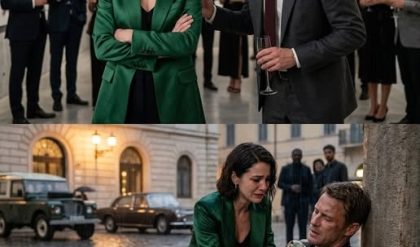
The richest woman in Chicago placed one perfectly manicured hand on my shoulder, tilted her champagne glass toward the man flexing near the bar, and said loudly enough for the whole ballroom to hear, “Beat my boyfriend at the table, and I’ll marry you.”
Three hundred people laughed.
Not chuckled. Not smiled politely. They laughed the way people laugh when they believe nothing real can happen to them, when the room is warm, the wine is expensive, and the person being mocked stands too far below them to matter.
I stood there in my one good shirt, the collar already biting the back of my neck, with drywall dust still hiding in the lines of my hands no matter how long I had scrubbed them. Across the room, under a chandelier that probably cost more than my apartment building, my seven-year-old daughter sat at a round table with a napkin in her lap and chocolate on her chin.
She was watching her father become a joke.
That was the part that changed everything.
The woman’s name was Victoria Vale. She was thirty-eight, the CEO of Vale Meridian Development, and half the skyline of Chicago had her company’s silver mark on it. Her boyfriend, Bryce Donovan, had a fitness brand, two million followers, a jaw like a billboard, and arms he seemed to believe were proof of character. Everyone called him a champion because he had won a few televised arm-wrestling exhibitions, the kind held under neon lights in sports bars where the announcers shouted like the fate of civilization depended on a man’s wrist.
I was just Liam Porter.
Forty-one years old. Single father. Ironworker. Local 63.
I had spent twenty-two years walking beams in the wind, bolting steel six hundred feet above streets filled with people who never once looked up long enough to wonder who had put the bones of their buildings in the sky. I had tied rebar until my fingers locked at night. I had carried tools so heavy they carved permanent grooves into my shoulders. I had watched men get old by forty-five and broken by fifty-two. I had gone to three funerals for men who left for work in the morning with lunch pails and never came home.
So when Bryce grinned at me from the little table they cleared in the middle of that ballroom, I did not see a champion.
I saw a man who had spent his strength on mirrors.
And I had spent mine staying alive.
But I am getting ahead of myself.
I need to tell you how a man like me ended up at a black-tie charity gala at the Grand Marlow Hotel in the first place, standing under crystal chandeliers while people in tuxedos and gowns decided whether I was amusing enough to deserve their attention.
The invitation came through the union hall.
The event was called Builders of Tomorrow, a grand charity dinner supposedly honoring “the tradesmen and tradeswomen who raise our city.” Those were the words printed on the cream-colored card, embossed in blue and silver. There were going to be scholarships announced, donations pledged, speeches made, photographs taken. A few representatives from the building trades were invited to attend with their families.
When my foreman, Ray Donnelly, asked if I wanted to go, I laughed.
I thought he was joking.
Ray did not laugh back. He just held the invitation out to me and said, “You should take Emma. She’ll like the desserts.”
That was how he got me.
My daughter’s name is Emma Rose Porter, but I call her Emmy when she is sleepy and Rosebud when she is pretending to be mad at me. She is seven, missing one front tooth, and has the kind of solemn brown eyes that make adults confess things they were not planning to say. Her mother and I split three years before the gala, not dramatically, not cruelly, just sadly. We had loved each other young and worn each other down by inches until staying together started feeling like teaching our daughter that love meant two people sighing in different rooms.
Now we share custody like careful diplomats. Her mother, Andrea, is a good woman. She teaches third grade, remembers every allergy at every birthday party, and still texts me when storms are coming because she knows I am usually up on steel when bad weather rolls in.
The weeks I have Emma are the weeks the world makes sense.
I do not drink those weeks. I do not take extra Saturday shifts unless I absolutely have to. I come home tired enough to fall asleep standing, but I still make dinosaur pancakes if she asks, even though my dinosaurs look like injured dogs. She is the reason I clip my harness every time, even when some young guy calls me cautious. She is the reason I check knots twice, bolts twice, everything twice.
A man can live carelessly when he thinks only his own life belongs to him.
A father knows better.
So I took the invitation home. Emma read the words aloud very slowly at the kitchen table, one finger moving under the letters.
“Grand Marlow Hotel,” she said. “Daddy, is that the place with the golden doors?”
Part 2: “It has brass doors,” I said.
“Is brass fancy gold?”
“It’s gold that went to trade school.”
She considered that and nodded, accepting the answer completely.
Then she asked, “Will there be cake?”
“I expect there’ll be something like cake.”
“What does something like cake mean?”
“It means rich people don’t always call cake cake.”
She narrowed her eyes. “That seems suspicious.”
“It is.”
She wore her blue dress, the one with tiny white stars on it, because she said if we were going to a fancy place she wanted to look “like the night sky, but polite.” I wore the charcoal shirt I had bought for my cousin’s wedding and the only tie I owned, a dark blue one Andrea had picked out for me back when we still thought marriage was a road you could repair if you just kept filling the cracks.
The Grand Marlow stood on Michigan Avenue, all stone arches and polished glass, the kind of hotel that makes you aware of your boots even after you cleaned them twice. Valets took keys from cars worth more than my yearly pay. Women stepped out of black SUVs wearing diamonds at their throats like small captured stars. Men adjusted cuff links and laughed into the cold November air.
Emma held my hand tighter as we walked in.
“Daddy,” she whispered, “are we allowed?”
That question hit me harder than I expected.
I looked down at her. “Yes, ma’am. Tonight they invited us.”
She looked up at the chandeliers beyond the lobby doors. “Do they know that?”
I almost smiled. Then I saw she was serious.
“They’ll figure it out,” I said.
Inside, the ballroom glowed like a movie. White flowers towered in glass vases. Waiters moved like ghosts. There were little cards with names printed on them, and a string quartet played near a wall of windows looking out over the city we had helped build. On every table sat candles floating in bowls of water, and their reflections trembled whenever someone walked past.
Emma stopped dead at the dessert display.
There was, as Ray had promised, a chocolate fountain.
Not a small one. A three-tiered machine spilling dark chocolate like some sacred waterfall. Around it were strawberries, marshmallows, pretzels, cubes of pound cake, and things I could not identify but suspected cost more per ounce than copper pipe.
Emma whispered, “Daddy, I have seen heaven.” —
The woman’s name was Victoria Vale. She was thirty-eight, the CEO of Vale Meridian Development, and half the skyline of Chicago had her company’s silver mark on it. Her boyfriend, Bryce Donovan, had a fitness brand, two million followers, a jaw like a billboard, and arms he seemed to believe were proof of character. Everyone called him a champion because he had won a few televised arm-wrestling exhibitions, the kind held under neon lights in sports bars where the announcers shouted like the fate of civilization depended on a man’s wrist.
I was just Liam Porter. Forty-one years old. Single father. Ironworker. Local 63.
I had spent twenty-two years walking beams in the wind, bolting steel six hundred feet above streets filled with people who never once looked up long enough to wonder who had put the bones of their buildings in the sky. I had tied rebar until my fingers locked at night. I had carried tools so heavy they carved permanent grooves into my shoulders. I had watched men get old by forty-five and broken by fifty-two. I had gone to three funerals for men who left for work in the morning with lunch pails and never came home.
So when Bryce grinned at me from the little table they cleared in the middle of that ballroom, I did not see a champion. I saw a man who had spent his strength on mirrors. And I had spent mine staying alive.
“Well?” Victoria purred, her eyes scanning the room for an audience. “Is there no one here with enough grit to challenge a real champion? Or are the ‘builders’ just talk?”
The room fell into an uncomfortable, titillating silence. Then, Bryce laughed. “Come on, fellas. It’s just for fun. Five thousand dollars to the winner, donated to the charity of their choice. Or, if you’re the betting type, you get the satisfaction of knowing you’re the strongest man in the room.”
I looked at Emma. She was busy with a chocolate-covered strawberry, oblivious to the fact that her father was currently being sized up as a spectacle. My blood, usually slow-moving and tempered by years of patience, began to hum with a low, dangerous heat.
I stood up. My chair scraped against the polished marble floor, a harsh, grating sound that drew every eye in the room.
“Daddy?” Emma asked, her eyes wide.
“Just a second, Rosebud,” I said, my voice steady. I walked toward the center of the room. I felt the weight of my work boots, the dust still lingering in the pores of my skin, contrasting sharply with the tuxedo-clad men whispering behind their champagne flutes.
I sat down opposite Bryce. He looked at my hands—calloused, scarred, the fingernails permanently stained with oil and steel dust—and his smile faltered, just for a fraction of a second.
“You really want to do this, pal?” he asked, his voice dripping with condescension.
“You made an offer,” I said.
He leaned in, his forearms thick with veins, groomed to perfection. He gripped my hand. His skin was soft, moisturized, alien to the reality of the construction site. I gripped him back, and I felt the difference immediately. He had the strength of a gym, but I had the strength of iron.
“On three,” the announcer shouted, a man who clearly loved the sound of his own voice. “One… two… THREE!”
Bryce slammed his strength against me. He expected me to topple, to provide a five-second show before he pinned me. But when he hit my wall, he didn’t find resistance; he found gravity. I didn’t push back with muscles alone; I pushed back with my skeleton, with the twenty-two years of supporting the weight of skyscrapers.
His eyes widened. The arrogance shifted to confusion, then to genuine panic. He strained, his face turning a blotchy, unbecoming red. The room had gone deathly quiet. Even the string quartet seemed to falter.
I looked directly into his eyes, not with hate, but with the cold, detached clarity of a man who has held onto a safety line while dangling over an abyss.
“You’re fighting for a mirror,” I whispered. “I’m fighting for my daughter.”
I didn’t jerk or slam. I just leaned forward, putting the weight of my entire life into the pressure of my shoulder. Bryce’s arm collapsed like a poorly welded joint. His hand hit the table with a loud thwack.
The silence that followed was absolute.
Victoria Vale looked like she had been slapped. The champion had lost, and the joke had landed squarely on the people who had tried to tell it.
“Five thousand,” I said, keeping my grip on his hand to ensure he couldn’t play it off as a slip. “Donate it to the Union Scholarship Fund. And keep the marriage proposal. I’m already married to the best woman I’ve ever known, even if we aren’t together anymore.”
I stood up, wiped my hand on my trousers, and walked back to Emma. She was watching me, her expression unreadable.
“Did you win, Daddy?”
“I did, sweetheart.”
“Is that why everyone is quiet?”
“Probably.”
“Can we go home now?”
“We can.”
As we walked toward the exit, Victoria Vale stood in our path. She looked at me, really looked at me, for the first time. She saw the dust, the cheap suit, and the steel-worker’s hands, but she also saw something that clearly unsettled her: a man who could not be bought, mocked, or broken by her world.
“You’re a proud man, Liam Porter,” she said, her voice sharp. “You could have had a career boost. You could have been a legend here.”
I looked at the brass doors, then back at her. “I’m already a legend to a seven-year-old girl. That’s the only promotion I need.”
We stepped out into the crisp November air. The city lights of Chicago glittered, beautiful and cold. I reached down and took Emma’s hand, feeling the small, trusting grip of my daughter. The gala, the champagne, the mocking laughter—it all faded away, becoming nothing more than a faint, unimportant memory.
I had built the city’s bones, and tonight, I had proven that those bones were stronger than the vanity that claimed to own them. We walked toward the subway, leaving the gold-plated world behind, and for the first time in a long time, the weight on my shoulders felt like nothing at all.
The end.