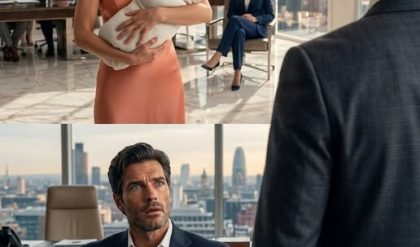
Ethan Whitmore should have smiled.
That was what the room expected.
Twelve executives, polished and precise, sat around a glass conference table high above Manhattan, waiting for their CEO to acknowledge a future worth nearly half a billion dollars. Whitmore Medical Technologies had just secured a hospital network deal that would reshape rehabilitation care across three states. The numbers on the screen were clean, elegant, undeniable.
Ethan Whitmore had built all of it.
And yet he was watching the rain.
It streaked down the glass wall behind him in long silver lines, turning the city into something blurred and distant. He used to think that view was beautiful. Laura used to stand beside him and say the skyline looked like hope. Milo used to press his tiny hands against the glass and ask if clouds ever got tired of carrying water.
Now Ethan only felt the absence of them like pressure in his chest.
His phone vibrated.
Once.
Then again.
He ignored it at first. Board meetings were sacred space. No one interrupted unless something was burning.
But the third vibration changed something in the air.
Ethan slid the phone out from his jacket beneath the table.
One notification.
Motion detected: Kitchen Camera 3.
His fingers tightened.
The cameras had been his idea—or at least that was the story he told himself when he signed the installation order six months earlier. After the accident. After the hospital. After Laura’s funeral had turned the world into something quieter and permanently off balance.
He had said it was for safety.
A child like Milo needed supervision. Constant care. Monitoring.
What he never admitted—even to himself—was that safety had slowly turned into control.
Ethan tapped the screen.
The conference room disappeared.
The kitchen at Willowbrook Lane appeared in sharp, unforgiving clarity.
Bright afternoon light. Marble counters. A row of copper pans Laura had chosen because she said they made the kitchen feel like it belonged to someone who still believed in warmth.
And on the floor—
Milo.
Ethan stopped breathing.
His son sat outside his wheelchair.
That alone should not have been possible.
The wheelchair stood abandoned beside the pantry like an object forgotten mid-sentence. Milo’s thin legs stretched across the hardwood floor. In front of him, a chaotic circle of overturned pots had been arranged with no structure except intention.
He held two wooden spoons.
And he was laughing.
Not the careful, measured smile people gave him when they didn’t know how to behave around a paralyzed child.
Real laughter.
Full-bodied. Uncontrolled. Alive.
He struck the pots again and again, joy echoing through the empty kitchen like something long trapped finally breaking free.
Ethan’s throat tightened so hard it hurt.
Then he saw her.
Behind Milo, half in frame, moving quietly between the counter and sink.
The maid.
Clara Hayes.
Clara did not belong in houses like Willowbrook Lane.
She knew that the moment she had been hired.
Everything in the Whitmore estate was too clean to trust. Too expensive to question. Even the silence had structure, like it had been designed by engineers rather than lived in by people.
She had arrived three weeks earlier with a tote bag, a uniform she had ironed twice, and a debt that had already started dictating her future. Her sister’s hospital bills were stacked in her mind like unstable scaffolding. Every shift she worked was measured in medicine, not money.
The rules of the house had been clear.
Do not interfere.
Do not improvise.
Do not deviate from care instructions.
Especially regarding Milo Whitmore.
Four years old. Paralyzed from the waist down after an accident no one spoke about directly. Nonverbal more often than not. Sensitive to noise, overstimulation, emotional instability.
A child, according to the file.
A fragile object, according to the household staff.
A liability, according to the hidden cameras Ethan Whitmore had installed in nearly every room.
Clara had seen them within the first day.
Small black lenses embedded into corners, smoke detectors, picture frames. Watching. Tracking. Recording.
Most caregivers behaved differently when they knew they were being watched.
Clara did not.
Because she had grown up being watched in worse ways.
And she had learned something important early in life:
Surveillance did not protect children.
Presence did.
On the third day, she noticed something the medical reports had not mentioned.
Milo reacted to rhythm.
Not words.
Not instructions.
Rhythm.
The first time she hummed while folding laundry in the kitchen, he turned his head.
The second time she tapped her fingers against the counter in a slow pattern, his eyes followed her hand.
The third time she accidentally dropped a metal spoon into a pot, making a soft clang—
Milo smiled.
It was so quick she almost missed it.
Almost.
Clara did not report it.
She adjusted instead.
Now, in the kitchen, she watched from a distance as Milo struck the pots again.
Clang.
Clang.
Pause.
Clang-clang.
She had learned his rhythm.
He had learned hers.
They were not speaking.
But they were communicating.
And for the first time since the accident, Milo was not watching a room like it might hurt him.
He was inside it.
Clara moved quietly to the counter, pretending to wipe a surface that was already clean.
Her eyes flicked once toward the corner camera.
It was still active.
Of course it was.
Ethan Whitmore never stopped watching.
In Manhattan, Ethan leaned forward so sharply the executives across from him went silent.
“What is this?” one of them asked.
Ethan did not answer.
He couldn’t.
Because something impossible was happening on the screen.
Milo lifted his arms.
Clara hesitated for half a second.
Then she stepped forward and placed her hands under his.
And she lifted him.
Not like a patient.
Not like a fragile object.
Like a child.
Milo’s legs hung loosely as she held him upright. She adjusted her stance, supporting his weight carefully, letting him balance against her arms.
Then she began to move him in a slow, rhythmic sway.
Left.
Right.
Pause.
Left.
Milo laughed harder.
Ethan’s grip tightened around the phone.
“No,” he whispered without meaning to.
One of the executives leaned closer. “Ethan, what is going on at your house?”
But Ethan wasn’t listening anymore.
Because Milo—his son, who had not stood independently since the accident—was now kicking one foot slightly against Clara’s hand.
Not walking.
Not fully.
But moving.
Participating.
Alive in a way Ethan had not seen in years.
And the maid—this woman he barely remembered hiring—was smiling.
Not professionally.
Not carefully.
Genuinely.
The next moment changed everything.
Clara set Milo down gently beside the pots again.
He reached for the spoons.
But instead of continuing the game, he turned his head toward the hallway.
Toward the hidden camera.
Straight at it.
Ethan froze.
For a split second, it felt like Milo was looking directly through the screen.
Then Milo lifted his small hand.
And waved.
Ethan’s breath stopped.
Because Milo had never done that.
Never acknowledged a camera.
Never reacted to anything outside the immediate world in front of him.
“Zoom in,” Ethan said sharply.
“What?” someone asked.
“Pull up the other feed,” he snapped. “All of it.”
A technician scrambled.
Within seconds, multiple camera angles filled his screen.
Kitchen. Hallway. Living room.
And Clara—standing in the kitchen—was looking directly at one of them.
Not at Milo.
At the surveillance system.
At him.
As if she knew exactly who was watching.
Clara had noticed the cameras on day one.
But she had also noticed something else.
They were not just recording.
They were analyzing.
Patterns.
Movement.
Response.
Milo’s progress was being measured by an algorithm designed by people who had never held a child who was afraid of their own reflection.
And Ethan Whitmore—grieving, brilliant, broken in ways money could not fix—was using data instead of touch.
Clara had not planned to interfere.
But Milo had reached for her hand on the second day.
And that had changed everything.
Because children did not reach for things they feared.
That night, Ethan drove faster than he should have.
He did not remember leaving the meeting.
He did not remember the questions.
He only remembered the image of his son laughing on the kitchen floor like the world had finally decided not to end.
When he arrived at Willowbrook Lane, the house was dark except for the kitchen light.
And Clara was waiting.
Not surprised.
Not afraid.
Just standing by the counter with her hands folded.
“You knew,” Ethan said immediately.
Clara met his eyes. “About the cameras?”
“Yes.”
“I suspected.”
“You used him.”
The words came out sharper than he intended.
Clara did not flinch.
“I helped him,” she said.
Ethan laughed once, humorless. “He’s paralyzed.”
“No,” Clara corrected softly. “He’s guarded.”
That made him pause.
“Explain.”
Clara glanced toward the kitchen where Milo slept in his chair, head tilted slightly, still holding one of the spoons.
“He doesn’t respond to instructions,” she said. “He responds to safety. To rhythm. To trust.”
“That’s not in his medical file.”
“No,” she said. “Because no one looked for it.”
Silence stretched.
Ethan’s voice lowered. “You’re not qualified to make decisions like this.”
Clara finally looked at him fully.
“I’m not making decisions,” she said. “I’m noticing your son is trying to come back to you and you’re watching him through walls instead of standing in front of him.”
The words hit harder than anger.
Because they were true.
Over the next week, Ethan began turning cameras off.
One by one.
He told himself it was temporary.
A test.
But the real reason was harder to admit.
He did not like what he saw when he watched without distance.
Milo did not behave like a patient around Clara.
He behaved like a child who was no longer afraid of his own body.
And Clara never once treated him like something broken.
The breakthrough came unexpectedly.
No doctors. No specialists.
Just a rainy afternoon when Milo tried to push himself up from the floor.
He fell.
Hard.
Ethan moved instinctively forward.
But Clara got there first.
And instead of lifting him immediately, she said something quietly:
“Again.”
Ethan froze.
“Excuse me?”
Clara didn’t look at him. She was watching Milo.
“Again,” she repeated gently.
Milo blinked.
Tears in his eyes.
Then he tried again.
His arms shook.
His body failed halfway.
But he tried.
And this time, Clara supported him instead of lifting him completely.
Ethan felt something in his chest crack open.
Because it wasn’t about walking.
It was about effort.
About agency.
About being allowed to struggle without being erased.
That night, Ethan turned off the remaining cameras.
All of them.
Not because he was certain.
But because for the first time in years, he realized he had been watching his son live instead of letting him.
Three months later, Milo said his first word since the accident.
Not “Dad.”
Not “Mom.”
The word was:
“Again.”
And Clara, standing behind him in the kitchen, simply smiled and said:
“Yes.”
And for the first time, Ethan Whitmore did not watch from behind glass.
He stood in the room.
The End